A Trustworthy PCB and Electronic Manufacturing Enterprise! Contact Us



Introduction
With the rapid growth of IoT, wearable devices, and compact electronics, space inside products is becoming increasingly limited. This is where FPC (Flexible Printed Circuit) antennas offer a clear advantage.
Compared to traditional PCB antennas or external antennas, FPC antennas provide flexibility in placement, lightweight structure, and ease of integration. However, achieving stable RF performance requires careful engineering beyond just the antenna layout.
This article focuses on the practical design and manufacturing considerations that directly impact FPC antenna performance.
1. Antenna Type and Frequency Planning
The first step in any FPC antenna project is defining the operating frequency and application scenario.
Common categories include:
Single-band antennas (e.g., 2.4 GHz for WiFi/Bluetooth)
Multi-band antennas (e.g., 2.4 GHz + 5 GHz, or GPS + LTE)
Wideband antennas for cellular or IoT applications
From an engineering perspective, antenna geometry is closely related to wavelength. In most designs, the effective length approaches a quarter wavelength (λ/4), adjusted by the dielectric constant of the substrate.
For multi-band or wideband designs, multiple resonant paths must be introduced, which increases complexity and requires simulation tools such as HFSS or CST.
2. Impedance Matching and Tuning Strategy
One of the most critical factors in antenna performance is impedance matching.
Typical target:
Characteristic impedance: 50Ω
Return loss: S11 < -10 dB (minimum), preferably below -15 dB
To achieve this, designers usually implement:
Pi matching networks (C-L-C)
L-type matching networks
In practical PCB design, it is essential to:
Reserve tuning pads
Allow space for component adjustment during testing
Even if the antenna performs well in standalone testing, performance can shift after integration due to:
Ground plane changes
Plastic enclosures
Nearby metal components
Therefore, final tuning must be done in the assembled product.
3. Placement and Layout Constraints
A well-designed antenna can still fail if placed incorrectly.
Key layout guidelines include:
• Keep away from metal
Metal parts such as batteries, shields, or frames can detune the antenna and reduce efficiency.
• Maintain a keep-out area
No copper, traces, or components should be placed near the antenna region. Usually, a clearance of at least 5 mm is recommended.
• Ensure proper ground reference
The antenna relies on the system ground as part of its radiation structure. Poor ground design will significantly degrade performance.
• Avoid high-speed signal interference
Keep the antenna away from high-speed lines (USB, DDR, etc.) to minimize EMI coupling.
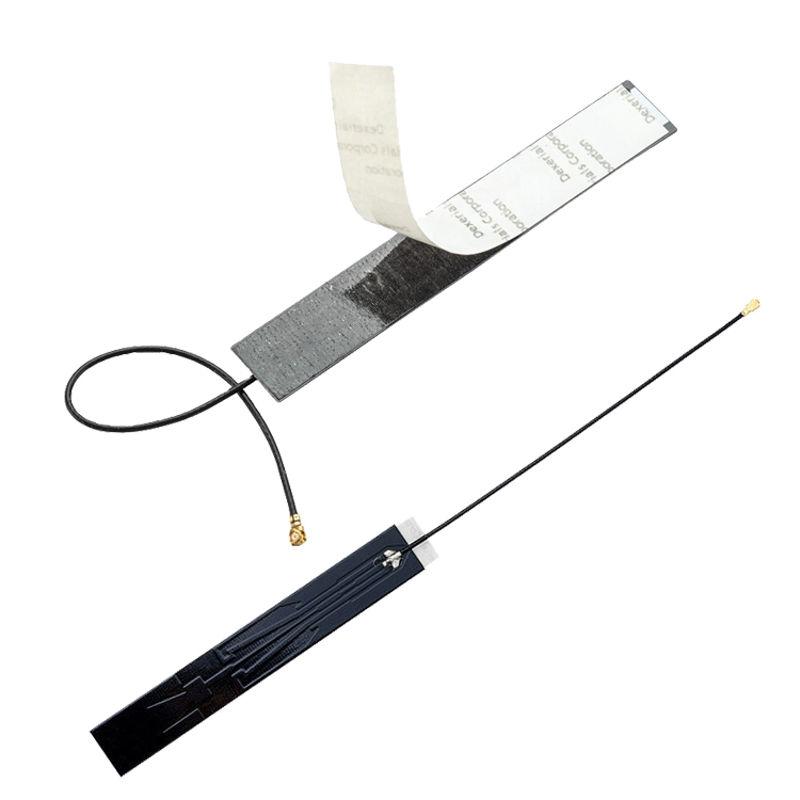
4. Material and Stack-up Impact
Material selection in FPC antennas directly affects RF behavior.
PI substrate
Dielectric constant: εr ≈ 3.2–3.5
Variations can shift resonant frequency
Copper thickness
Thin copper reduces conductor loss at high frequencies
Coverlay
Influences electromagnetic field distribution
Thickness variations may detune the antenna
Adhesive layer
Acts as an additional dielectric
Can alter impedance matching
Best practice:
Always perform tuning with the final stack-up, including adhesive and enclosure.
5. Testing and RF Validation
FPC antennas must be verified using both lab instruments and system-level testing.
Key parameters:
Return loss (S11)
Radiation efficiency
Gain
Radiation pattern
Equipment:
Vector Network Analyzer (VNA)
Anechoic chamber for OTA testing
For commercial products, compliance with CE, FCC, or RED standards is often required, making OTA validation essential.
Conclusion
FPC antenna design is not just about creating a flexible circuit—it is a system-level RF engineering task involving:
Frequency planning
Impedance matching
Layout optimization
Material control
System integration