A Trustworthy PCB and Electronic Manufacturing Enterprise! Contact Us



With the rapid development of UAV technology, drone antennas, as a critical component of communication systems, are widely used in aerial photography and mapping, agricultural plant protection, power line inspection, logistics and transportation, emergency rescue, and consumer entertainment. They are an important foundation for ensuring stable communication, high-speed data transmission, and precise control. A UAV antenna is a crucial device that allows the drone to communicate with the remote controller, other devices, and systems by sending and receiving radio waves. These antennas enable the basic functions of the drone, such as navigation, data transmission, and operation of onboard systems, making them indispensable components for the performance and practicality of unmanned aerial vehicles (UAVs).

drone antenna
What is the function of a drone antenna?
Drone antenna are responsible for the transmission and reception of signals between the drone and the remote controller or ground station, playing a crucial role in ensuring the safe and efficient flight of the drone. When the drone receives a signal from the remote controller, it processes the command and performs the corresponding action. For example, if the pilot wants the drone to ascend, they push the throttle stick upwards, which sends a signal to the drone via the antenna. The drone then increases motor power and begins to ascend.
Similarly, when the drone sends a signal to the remote controller, it provides information about its flight status, such as altitude, speed, battery level, and GPS coordinates. This information is displayed on the remote controller's screen, allowing the pilot to monitor the drone's flight and make necessary adjustments.
UAV antennas ensure that these signals are transmitted and received effectively, even over long distances. They need to be designed to provide a strong and stable connection, minimizing signal loss or interference. This is especially important for drones flying in areas with obstacles or interference, such as buildings or crowded urban environments.
Types of drone antennas
Several types of unmanned aerial vehicle (UAV) antennas are commonly used for communication and data transmission purposes. Some common types of UAV antennas include:
1. Dipole Antenna: A dipole antenna consists of two conductive elements arranged along the same axis. It is a simple and commonly used UAV antenna due to its small size and omnidirectional radiation pattern.
2. Patch Antenna: A patch antenna is a flat, rectangular, or circular antenna widely used in UAVs for GPS and communication. It provides a directional radiation pattern and is known for its high gain and low profile.
3. Helical Antenna: A helical antenna is an antenna with a helical structure. Due to its high gain and directional radiation pattern, it is commonly used for long-range communication in drones.
4. Yagi Antenna: A Yagi antenna is a directional antenna composed of multiple elements, including a driven element, a reflector, and one or more directors. It is commonly used for long-distance communication and has high gain.
5. Parabolic Antenna: A parabolic antenna consists of a parabolic reflector and a feed antenna placed at its focal point. It is used for long-distance communication and has high gain and a narrow beamwidth.
6. Omnidirectional Antenna: An omnidirectional antenna radiates and receives signals uniformly in all directions. It is commonly used for short-range communication and is suitable for applications where a drone needs to communicate with multiple ground stations simultaneously.
What is antenna gain?
Antenna gain refers to the ratio of the square of the field strength produced by an actual antenna to that of an ideal radiating element at the same point in space, under equal input power conditions. It quantitatively describes the degree to which an antenna concentrates the input power for radiation. Gain is clearly closely related to the antenna radiation pattern; the narrower the main lobe and the smaller the side lobes of the radiation pattern, the higher the gain.
The gain of an antenna compared to a symmetrical dipole is expressed in "dBd".
The gain of an antenna compared to an isotropic radiator is expressed in "dBi" (3 dBd = 5.17 dBi).
Higher antenna gain means better directivity, more concentrated energy, and a narrower beamwidth. Higher gain generally corresponds to a longer antenna length.
In drone antenna systems, the drone antenna printed circuit board (PCB) also plays a crucial role. The RF performance of the antenna depends not only on the antenna structure itself but also on the circuit board material, stacking structure, trace layout, and impedance control. It can be said that a high-quality drone antenna PCB is the foundation for achieving stable RF performance.
When designing a drone antenna PCB, you need to use rigid PCBs or rigid-flex PCBs to accommodate various circuits. The most important systems include the control board, power supply, navigation, and communication circuits. These circuit boards enable drones to operate reliably and maintain stable flight. A rigid-flex PCB is a suitable choice; this hybrid circuit board contains both rigid and flexible circuits, allowing it to be bent and folded into confined spaces. This reduces weight and improves overall flight efficiency.
Control Circuit Board
The drone's flight controller processes information from sensors and sends signals to the drone's motors and other components. The main processor (MCU), sensors (IMU), and electronic speed controllers (ESC) are all integrated into it. This control board manages the speed of the drone's motors in real-time based on your commands and sensor data.
Power Circuit Board
The drone's electronic components are powered by a power circuit board, or power distribution board (PDB). It utilizes the raw power provided by the battery to supply the correct voltage and current to each component. This board has the necessary overcurrent and overtemperature protection features to ensure your drone operates reliably.
Navigation Circuit Board
The drone's navigation circuit board is used to determine its precise location and flight direction. The GPS module located on the drone's circuit board receives signals from satellites to calculate its position. To improve data accuracy, this circuit board can be equipped with additional sensors, such as a barometer for measuring altitude and an inertial measurement unit (IMU) for measuring direction.
Communication Circuit Board
Your drone uses a communication circuit board to send and receive information. It is usually equipped with radio control and video transmission modules to connect the aircraft to the ground station. This circuit connects your drone to the remote control and FPV goggles, allowing you to control its flight.
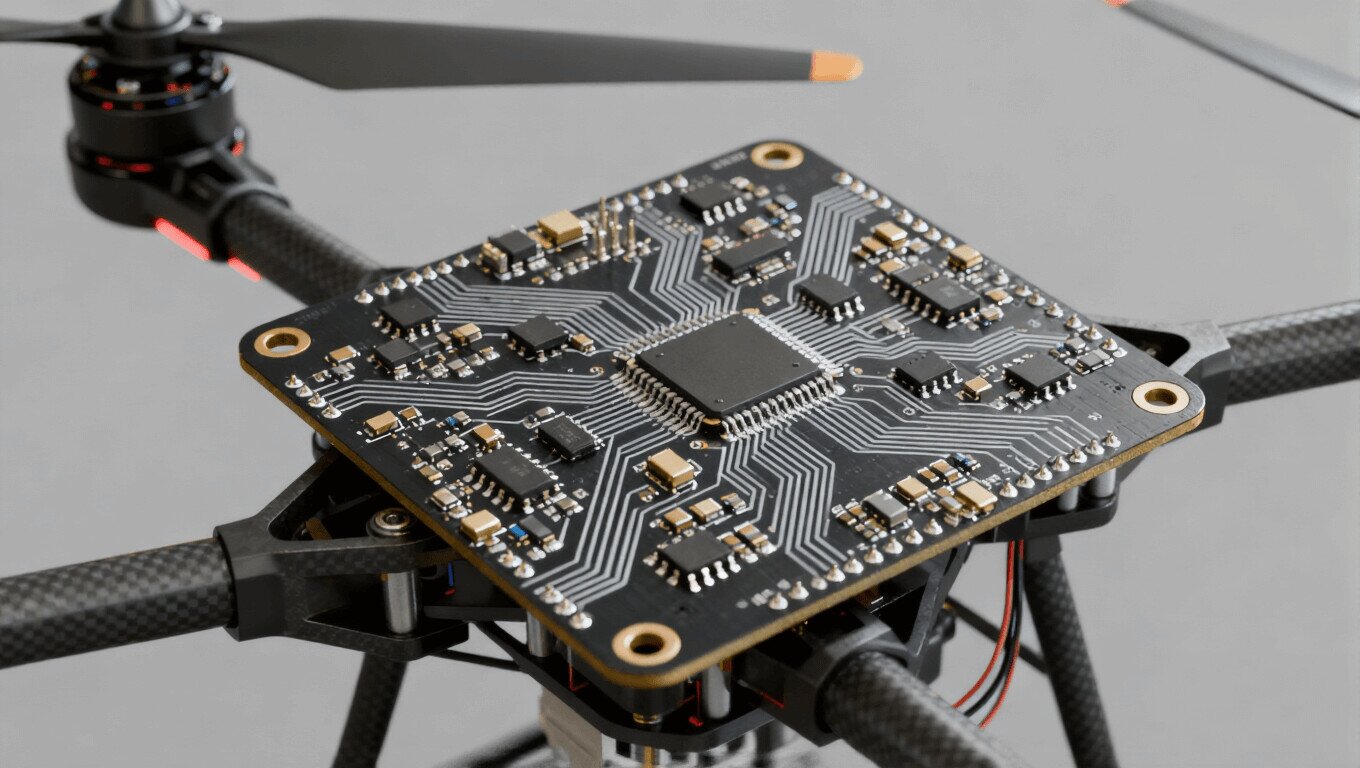
drone antenna pcb
With the development of 5G, satellite communication, and intelligent formation technology, drone antennas are evolving towards multi-band, high integration, and intelligence. Future drone antennas will not only perform signal transmission and reception but may also possess functions such as adaptive tuning and environmental sensing to adapt to more complex application scenarios. At the same time, the collaborative design of drone antennas and drone antenna circuit boards will become more closely integrated, achieving true integrated optimization from material selection and structural design to manufacturing processes. This will further improve the overall performance and reliability of the drone communication system. In the future, drone antennas will continue to play a key role in technological innovation, driving the drone industry to a higher level of development.