A Trustworthy PCB and Electronic Manufacturing Enterprise! Contact Us


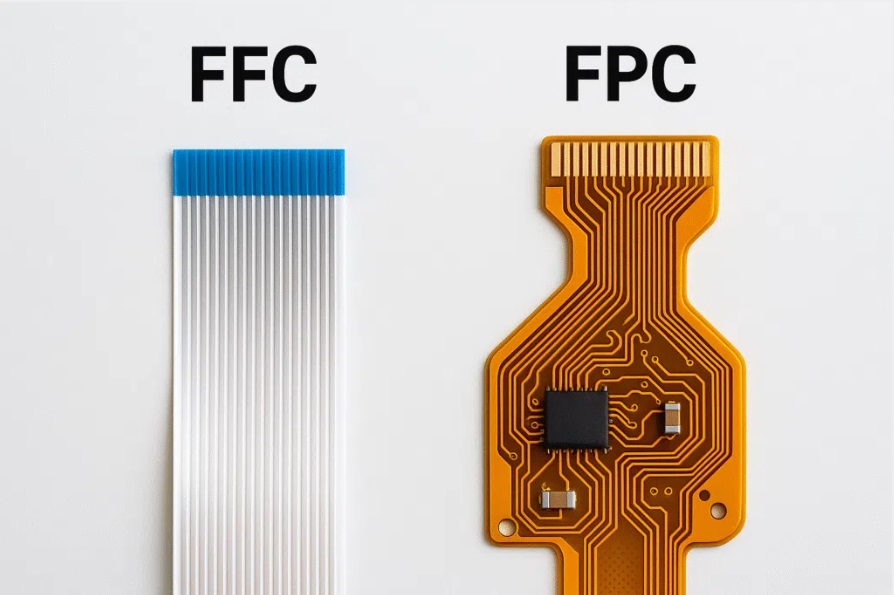
In practical product development, FFC (Flat Flexible Cable) and FPC (Flexible Printed Circuit) are often evaluated at the same design stage. Although their external appearance is similar, they differ significantly in material systems, manufacturing processes, electrical performance, and long-term reliability.
The following analysis compares them from four core engineering dimensions.
1. Structural and Material Differences
1.1 Structure and Material System of FFC
FFC is essentially a multi-conductor flat cable. The conductors are typically rolled annealed (RA) copper or electrolytic copper strips with a flat rectangular cross-section. These conductors are arranged in parallel and laminated between two insulation films using thermal bonding.
Typical structure:
Top insulation layer (PET or PI)
Parallel copper conductors
Bottom insulation layer
Exposed contact area (tin- or gold-plated)
Material characteristics:
Insulation material: PET (cost-effective) or PI (higher temperature resistance)
Copper thickness: commonly 12μm / 18μm / 35μm
Standard pitch: 0.5mm, 1.0mm, 1.25mm
Because the conductors are straight and equally spaced, FFC does not allow:
Trace routing variations
Branching
Vias
Power/ground plane separation
Electrically, FFC behaves as a parallel multi-core cable rather than a designed circuit.
1.2 Structure and Material System of FPC
FPC belongs to the printed circuit board family. The base material is copper-clad polyimide (PI). Circuit patterns are formed through photolithography and chemical etching, followed by coverlay lamination for protection.
Typical single-layer FPC stack-up:
Coverlay (PI + adhesive)
Etched copper circuitry
PI substrate
Optional stiffener
For double-sided or multilayer FPC, additional layers may include:
Multiple copper layers
Plated through-holes or laser microvias
Bonding sheets
Local stiffeners (FR4 or stainless steel)
Key material characteristics:
Copper type: RA copper (better flexibility) or ED copper
PI thickness: 12.5μm / 25μm / 50μm
Finished thickness: typically 0.1mm–0.3mm
The fundamental advantage of FPC lies in its design flexibility. Circuit geometry, shape, and layer structure can be customized to meet electrical and mechanical requirements.
2. Manufacturing Process Comparison
2.1 FFC Manufacturing Process
FFC production is primarily mechanical and does not involve photolithography or etching.
Typical process flow:
Parallel alignment of copper conductors
Thermal lamination with insulation films
Die cutting and forming
Contact area exposure
Surface plating (tin or gold)
Process characteristics:
High automation level
Short production cycle
Limited process variables
No alignment control for circuit patterns
However, once the pitch and tooling are defined, design modification is minimal.
2.2 FPC Manufacturing Process
FPC fabrication is similar to rigid PCB production but requires stricter stress and material control.
Typical process flow:
Copper-clad PI panel preparation
Dry film lamination
UV exposure and development
Chemical etching
Film stripping and cleaning
Coverlay lamination
Laser opening
Drilling (mechanical or laser)
Copper plating or electroless deposition
Surface finishing (ENIG, OSP, immersion tin, etc.)
For multilayer FPC, additional lamination and layer alignment steps are required.
Critical process control points include:
Etching compensation (±10μm tolerance)
Lamination temperature and pressure profile
Moisture absorption control of PI
Copper plating thickness uniformity
Compared to FFC, FPC involves significantly higher process complexity but enables much greater precision and customization.
3. Electrical Performance and Design Capability
3.1 Impedance Control
FFC lacks a continuous reference ground plane. Its impedance depends mainly on conductor width and spacing, with limited control capability.
In high-speed applications, impedance deviation can be substantial, making FFC unsuitable for data rates above certain thresholds.
FPC, on the other hand, enables impedance control through:
Precise trace width and spacing (down to 50μm scale)
Dedicated ground planes
Controlled dielectric properties (PI dielectric constant ≈ 3.2–3.5)
Simulation-based impedance calculation
Typical impedance tolerance:
Single-ended: ±10%
Differential: within ±10%
For interfaces such as LVDS or MIPI, length matching can be controlled within ≤5 mils.
3.2 Current Carrying Capacity
In FFC, current capacity is fixed by the copper strip cross-section. Local reinforcement is not possible.
In FPC, current distribution can be optimized by:
Widening power traces
Increasing copper thickness to 1 oz or higher
Using multi-layer parallel power routing
This makes FPC more suitable for LED drivers, motor control, or other moderate power applications.
3.3 EMI and Signal Integrity
FFC lacks shielding layers and controlled return paths, which can result in:
Crosstalk
Impedance discontinuities
Higher electromagnetic emission
FPC can improve EMI performance through:
Continuous ground planes
Differential pair routing
Optional shielding layers
As a result, FPC generally achieves higher EMC compliance reliability.
4. Mechanical Stress and Dynamic Lifetime
4.1 Bending Radius
Recommended bending radius for FFC:
Static bending ≥10× thickness
Not recommended for long-term dynamic flexing
Because conductors are straight strips, stress concentrates on the outer bending surface, increasing fatigue risk.
For FPC with RA copper:
Static bending radius can be reduced to approximately 6× thickness
Dynamic flex life can exceed 10,000 cycles depending on design
Design techniques used in dynamic FPC applications include:
Teardrop pads
Gradual bending transition zones
Avoidance of vias in bending areas
4.2 Typical Failure Modes
Common FFC failures:
Conductor fracture
Contact oxidation
Wear at insertion area
Common FPC failures:
Copper fatigue cracking
Coverlay delamination
Via fatigue (in multilayer designs)
With proper stack-up design and stress management, FPC reliability can be engineered and optimized more effectively.
Conclusion
FFC is a standardized flat cable solution suitable for low-speed, low-complexity, cost-sensitive point-to-point connections.
FPC is a customizable flexible circuit platform capable of impedance control, multilayer routing, functional integration, and dynamic bending applications.
The fundamental distinction is not flexibility, but design capability and system integration level.
In early-stage product evaluation, focusing solely on unit cost without considering electrical margin and long-term reliability may lead to higher validation and field failure risks later.
Proper selection should be based on performance requirements, mechanical constraints, and system architecture rather than superficial structural similarity.