A Trustworthy PCB and Electronic Manufacturing Enterprise! Contact Us


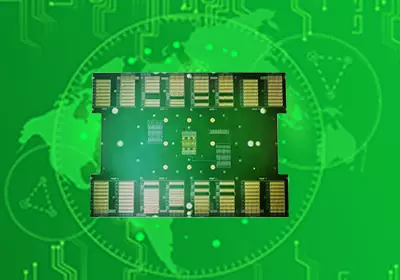
High-frequency PCBs (HF PCBs) are printed circuit boards designed for the transmission of high-frequency signals. In modern communication systems, radar, 5G base stations, RF equipment, and satellite navigation systems, high-frequency PCBs play a critical role in signal transmission and processing. Compared with conventional rigid FR‑4 boards, HF PCBs demand higher standards for materials, electrical performance, and manufacturing precision.
1. What Is an HF PCB? How Does It Differ from a Standard PCB?
Standard PCBs usually use FR‑4 substrates, suitable for low- to mid-frequency digital or analog circuits (<100 MHz). However, FR‑4 suffers from high dielectric loss and unstable dielectric constant in high-frequency applications.
HF PCBs, on the other hand, are designed for high-frequency circuits, with the following critical requirements:
1.Dielectric Constant (Dk): Low and stable Dk reduces signal propagation delay and distortion.
Typical FR‑4: Dk ≈ 4.2–4.8
High-frequency materials: Dk ≈ 2.2–3.0 (e.g., Rogers 4350B: Dk≈3.48; RO3003: Dk≈3.0)
2.Dielectric Loss (Df / Tan δ): Low loss is crucial for high-frequency operation.
FR‑4: Tan δ ≈ 0.02–0.025
High-frequency materials: Tan δ ≈ 0.0013–0.0035
3.Impedance Control: High-frequency traces require precise impedance control (typically ±5%).
4.Coefficient of Thermal Expansion (CTE) Matching: HF PCBs should match metalized layers to ensure reliability.
In summary, the fundamental difference between HF PCBs and standard PCBs lies in electrical performance and material stability. HF PCBs are specialized structures optimized for high-frequency signal transmission.
2. HF PCB Material Selection and Properties
The core of HF PCB design is the material system. Common high-frequency PCB substrate materials include:
1. PTFE (Polytetrafluoroethylene) Substrates
Representative Materials: Taconic, Nelco, Rogers Teflon series
Advantages: Lowest dielectric loss, very stable Dk
Disadvantages: Difficult to process, high water absorption, high cost
Typical Parameters: Dk ≈ 2.1–2.3; Tan δ ≈ 0.0009–0.002
2. Ceramic-Filled Composite Materials
Representative Materials: SiO₂/Ceramic-filled PTFE composites
Advantages: Tunable dielectric constant, good thermal stability
Typical Parameters: Dk ≈ 2.5–3.2; Tan δ ≈ 0.0015–0.003
3. Polyimide / Glass-Reinforced (High-Performance Resin)
Dielectric properties fall between FR‑4 and PTFE
Advantages: Good manufacturability, relatively lower cost
Disadvantages: Higher dielectric loss compared to PTFE
Material Comparison Table (Typical Values)
Material Type Dk (@1GHz) Tan δ Applicable Frequency
FR‑4 4.4 0.02 <500 MHz
Rogers RO3003 3.0 0.0013 <10 GHz
Rogers 4350B 3.48 0.0037 2–6 GHz
PTFE Ceramic-Filled 2.2–2.6 0.0009–0.002 5–20 GHz
3. HF PCB Design and Manufacturing Challenges
Designing and manufacturing HF PCBs requires deep understanding of high-frequency signal behavior and precise process control, rather than simply replicating standard PCB processes.
1. Impedance Control
High-frequency traces must maintain strict impedance matching (e.g., 50Ω/75Ω). Deviations can lead to reflections and signal distortion.
Simulation Tools: HFSS, ADS, Siemens HyperLynx
Design Considerations: Trace width, spacing, layer thickness, dielectric constant, copper foil thickness
2. Surface Roughness Management
HF PCBs are highly sensitive to copper surface roughness.
Higher roughness → higher signal loss
Particularly for signals >5 GHz, loss increases exponentially with roughness
3. Lamination and Pressing Process Control
Proper temperature, pressure, and time curves are required to bond high-frequency substrates with copper layers. Poor control may cause delamination or voids.
4. Via and Through-Hole Processes
HF PCBs often require blind, buried, or stacked vias (BD/VI), increasing manufacturing complexity and impacting yield.
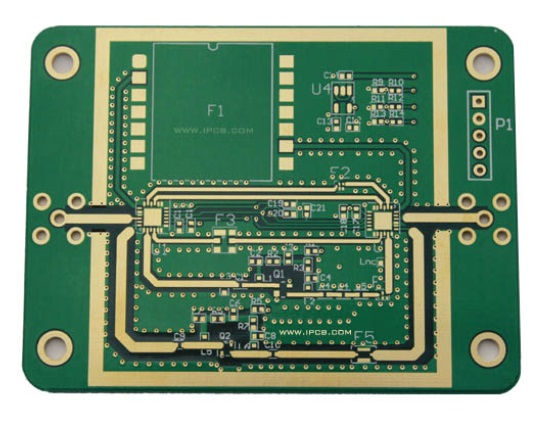
4. Typical Applications and Industry Requirements
HF PCBs are indispensable in several high-end fields due to their superior high-frequency characteristics:
1.5G Communication Base Stations
Frequency coverage typically 2.5 GHz, 3.5 GHz, 28 GHz, and above
Low dielectric loss and precise impedance control are required
HF PCBs are used for RF front-ends, filters, and antenna matching networks
2.RF / Microwave Equipment
Radar, electronic warfare (EW), satellite communication
Signal loss can be as low as –0.3 dB/inch @10 GHz
High-Frequency Test and Measurement
Oscilloscope probes, signal generators, network analyzers
PCB material must maintain stable Dk and low loss across a wide frequency range
5. HF PCB Quality Control Indicators
Key electrical parameters tested in HF PCB production include:
Parameter Test Method Standard Requirement
Dielectric Constant (Dk) TDR / Lab measurement ±5% stability
Dielectric Loss (Tan δ) Network analyzer Below target frequency limit
Impedance Control TDR ±5%
Water Absorption IEC 60115 ≤0.2%
Surface Roughness Ra 3D profilometer <1.0 μm (some high-frequency areas >0.5 μm)
6. Conclusion and Recommendations
HF PCBs form the core structural layer of high-frequency systems, with material, electrical, and process requirements far exceeding those of conventional FR‑4 PCBs.
Material selection must align with target frequency and system specifications
Impedance, dielectric loss, and process precision must be strictly controlled
For high-end communications, radar, and millimeter-wave applications, the value of HF PCBs lies in lower insertion loss, more stable signal transmission, and higher reliability