A Trustworthy PCB and Electronic Manufacturing Enterprise! Contact Us


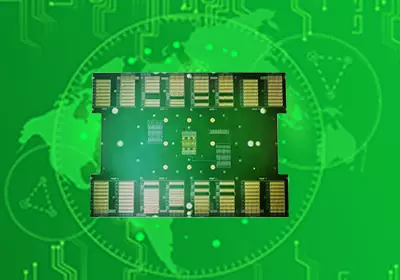
Drone PCB design plays a pivotal role as drone technology rapidly advances, with more application scenarios placing higher demands on performance—specifically regarding flight stability, endurance, communication efficiency, and interference immunity.
The Core Function of Drone PCBs
The drone PCB serves as the foundational platform connecting various electronic components. Its primary functions include:
1. Flight Control Signal Transmission: The drone's flight control system requires high-speed, stable signal transmission to ensure precise maneuverability across diverse environmental conditions.
2. Power Management: Given the limited capacity of drone batteries, the PCB must efficiently distribute electrical power while ensuring the safe and stable operation of power modules and motor drive circuits.
3. Communication and Data Transmission: This encompasses remote control signals, GPS positioning data, and video transmission signals; the PCB is required to accommodate high-speed communication lines and minimize electromagnetic interference (EMI).
4. Sensor Integration: For sensors mounted on the drone—such as gyroscopes, accelerometers, and barometers—the PCB must provide reliable signal interfaces and filtering circuits.
Consequently, high-quality PCB design directly impacts a drone's flight performance, reliability, and safety.
Design Characteristics of Drone PCBs
Compact dimensions, suitable for installation within limited space
Lightweight materials, reducing the overall weight burden on the aircraft
High reliability, capable of withstanding intense vibration and high-speed flight
High-frequency signal support, compatible with GPS, video transmission, and remote control communication modules
Compared to standard PCBs, drone PCBs demand more rigorous standards regarding design, material selection, layer stacking, and signal integrity.
Material Selection for Drone PCBs
Drone PCB materials must strike a balance between lightweight properties, high-speed signal performance, and reliability:
1. FR4 High-Tg Materials: FR4 is a widely used PCB substrate material; high-Tg (Glass Transition Temperature) variants are capable of withstanding the temperature fluctuations inherent in drone operating environments, making them suitable for general flight control and power management circuitry.
2. Rogers High-Frequency Materials: For wireless communication modules (such as 2.4GHz remote control and 5.8GHz video transmission systems), utilizing Rogers or similar low-loss materials can effectively reduce signal attenuation and enhance transmission efficiency.
3. Metal Substrates and Heat Dissipation Materials: For high-power motor driver boards, metal-core PCBs or thick copper layers can enhance heat dissipation capabilities, preventing excessive temperature rise that could compromise system stability.
4. Polyimide (PI): Used in flexible circuits, offering excellent heat resistance properties.
5. Ceramic Substrates: Commonly used in high-frequency radar systems or power modules.
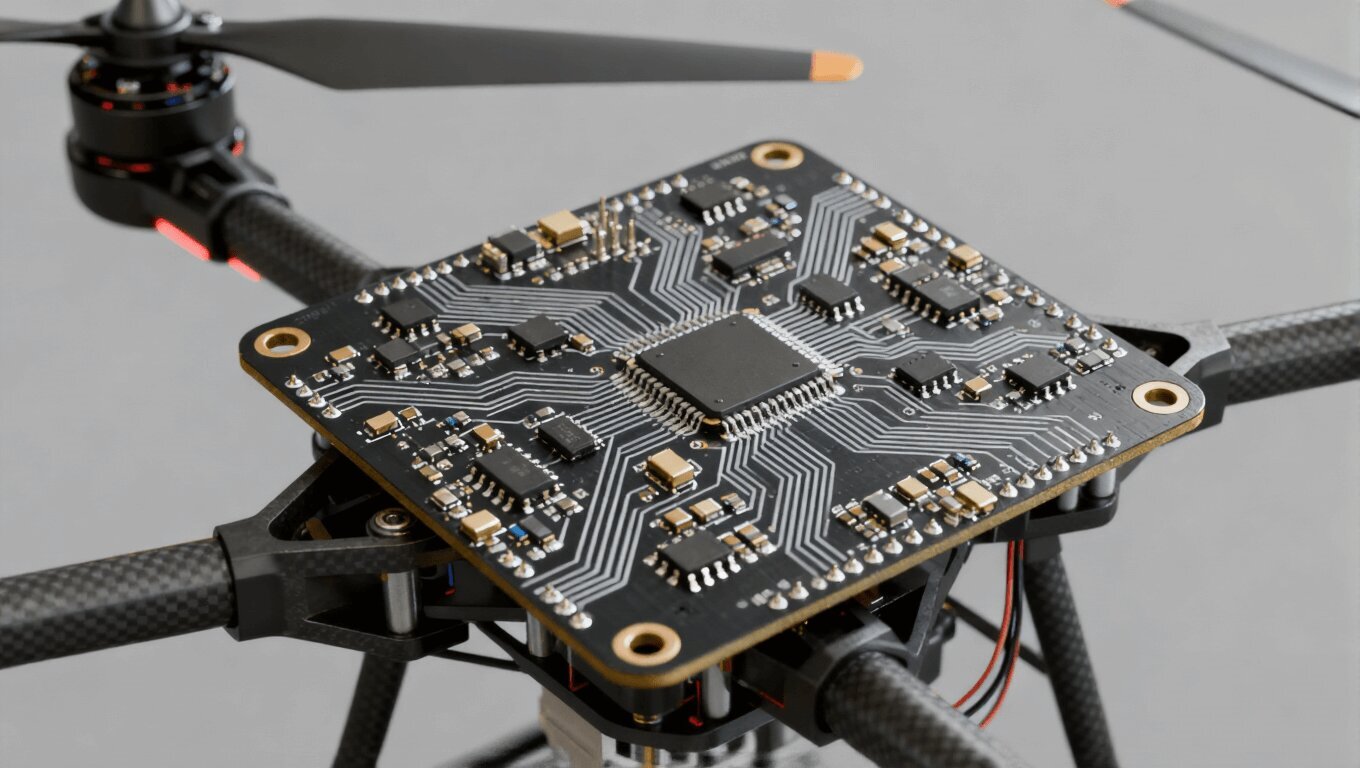
Common PCB Types Used in Drones
Depending on the specific application scenario, drones may utilize the following types of PCBs:
1. Rigid PCBs: These are the most common type, offering excellent structural integrity and reliability. They are suitable for areas requiring stable component placement and secure connections, such as the main flight controller. Rigid PCBs are cost-effective in many applications, though they may add to the overall weight.
2. Flex PCBs: Constructed using flexible plastic substrates, these circuits can be bent or folded, making them ideal for space-constrained designs or situations where connections must span across different sections of the drone. Compared to rigid circuit boards connected via cables, they offer reduced weight and a smaller form factor.
3. Rigid-Flex PCBs: Combining the advantages of both types, rigid-flex PCBs feature a design that integrates rigid sections—used for component mounting—with flexible sections used for interconnection. Due to their ability to save space, reduce weight, and enhance reliability by minimizing the number of connectors, this design is becoming increasingly popular in advanced drone electronics. They are particularly well-suited for accommodating the complex geometries often found within drones.
4. Multilayer PCBs: Most drone PCB assemblies (PCBAs) are multilayer PCBs, consisting of multiple conductive layers separated by insulating materials. This design enables higher component density, improved signal integrity, and superior power distribution—factors that are critical for the high-speed signals and complex circuitry typically found in flight controllers and video processing units.
5. HDI PCBs: HDI PCBs are a type of multilayer PCB characterized by a significantly higher routing density per unit area. They utilize microvias, finer traces, and denser pad layouts to achieve further miniaturization and deliver superior electrical performance. HDI technology is critical for compact, high-performance drones that face space constraints and require precision circuitry to support complex functions—such as advanced image processing.
Key Design Considerations for Drone PCB Routing
Power and Ground Plane Design
In multi-layer PCB designs, power layers and ground planes are typically designated as separate, dedicated layers to establish complete current return paths, thereby minimizing EMI interference and power supply noise.
High-Speed Signal Contro
Strict impedance matching and length matching must be applied to differential signal pairs (such as those in CAN buses or SPI interfaces) to prevent signal reflection and crosstalk.
Thermal Management Design
High-frequency chips, motor driver ICs, and power management modules require careful placement; the incorporation of thermal copper pours and thermal vias is essential to ensure thermal equilibrium across the PCB.
Routing Guidelines
Route high-frequency signals using straight lines whenever possible to minimize bends.
Avoid routing signal traces parallel to high-current power traces.
Utilize filtering and decoupling capacitors to reduce noise.
The drone PCB serves as the fundamental backbone of a drone's performance. Judicious material selection, optimal layer stackup design, high-speed signal routing, thermal optimization, and high-quality manufacturing processes directly influence a drone's flight stability, endurance, and overall reliability. As drones become increasingly ubiquitous across consumer, industrial, agricultural, and defense sectors, the technical demands placed on PCBs will continue to escalate; future drone PCBs are expected to evolve toward higher layer counts, greater density, higher operating frequencies, and increased flexibility.