A Trustworthy PCB and Electronic Manufacturing Enterprise! Contact Us


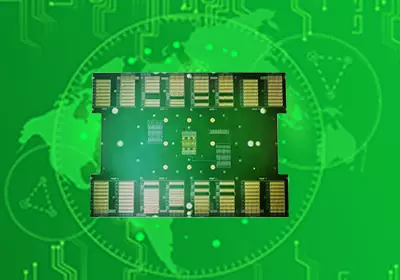
Rogers circuit board materials generally refer to a series of high-frequency, high-speed dedicated copper-clad laminate materials developed and manufactured by Rogers Corporation. Compared with traditional FR-4 materials, Rogers materials have significant advantages in high-frequency performance, dielectric stability, loss control, and thermal performance, and are therefore widely used in radio frequency (RF), microwave, millimeter-wave, high-speed digital circuits, as well as high-end fields such as aerospace, 5G communications, and automotive radar.
With the continuous increase in communication frequencies, from the early hundreds of MHz to today's GHz and even millimeter-wave bands, ordinary FR-4 materials are no longer sufficient to meet the requirements of signal integrity and low-loss transmission. Against this backdrop, Rogers high-frequency materials have gradually become a key fundamental material in the design of high-end electronic products.
Rogers circuit board materials are the industry standard for high-performance high-frequency boards, renowned for their excellent low dielectric loss (Df), stable dielectric constant (Dk), high thermal conductivity, and reliable temperature stability. The main products include the ceramic-filled RO4000 series, the PTFE-based RT/duroid series, and the RO3000 series, designed specifically for 5G, radio frequency (RF), and microwave applications.
Core Advantages and Characteristics
1. High-Frequency Characteristics: Suitable for high-frequency signal transmission above 500MHz with extremely low loss (e.g., Df < 0.003).
2. Thermal Stability: Excellent thermal conductivity and a high decomposition temperature, suitable for high-power components.
3. Mechanical Characteristics: Good dimensional stability, high reliability, and strong resistance to harsh environments.
Common Applications and Materials
1. RO4000 Series (e.g., RO4350B, RO4003C): The RO4000 series is one of the most widely used Rogers high-frequency materials, such as RO4003C and RO4350B. These materials use a hydrocarbon resin and ceramic filler system, balancing high-frequency performance and processability, and are widely used in 5G base station RF circuits and power amplifier modules.
2. RO3000 series (e.g., RO3003): Based on polytetrafluoroethylene (PTFE), featuring extremely low loss, suitable for microwave communications.
3. RT/duroid series (e.g., RT5880): Rogers RT/duroid is a material specifically designed for high-frequency circuits, filled with PTFE laminate. It is the most durable and reliable, used in aerospace and defense. Its reliability has secured a broad market share.
4. TMM series: TMM thermosetting microwave materials. The TMM series offers a range of thermosetting microdispersed ceramic-filled materials covering a wide range of dielectric constants for broadband applications. Options include TMM3, TMM4, TMM6, TMM10i, etc.
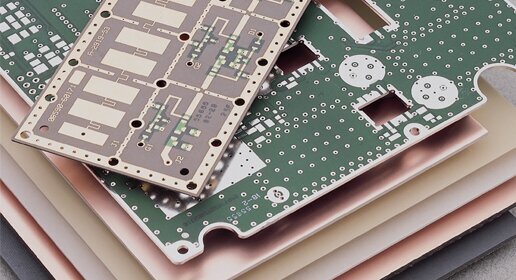
rogers circuit board material
How to Choose Rogers Circuit Board Materials?
Before selecting Rogers circuit board materials, we need to understand the device's functions and requirements. Then we compare the following key parameters.
1. Frequency: This material is the optimal choice for high-frequency applications. For example, RO3003 operates at frequencies up to 10 GHz, while RT/DROID 6002 operates at frequencies up to 90 GHz.
2. Dielectric Constant: It is well known that high-frequency applications require a low dielectric constant. Therefore, Rogers materials are the best choice in this case. The lower the dielectric constant, the larger the capacitance and the lower the impedance. Thus, we can achieve optimal impedance matching.
3. Loss Tangent: The loss tangent represents the signal loss caused by the material. If the material has a low tangent loss, dissipation, attenuation, and signal integrity issues will be lower. Therefore, Rogers RO4350B and RO4003C are the best choices.
4. Coefficient of Thermal Expansion: Materials expand when the temperature rises above a certain level, and in this case, Rogers materials are much better than other materials.
5. Glass Transition Temperature: It has a good glass transition temperature value and can survive at high temperatures.
6. Peel Strength: Exhibits excellent peel strength.
7. Flammability Rating: Complies with UL 94 and IPC standards.
Rogers Circuit Board Material's Main Application
1. 5G Communication Systems
Rogers materials are used to reduce signal loss and improve transmission efficiency in 5G base station antenna arrays, RF front-end modules, and power amplifiers.
2. Automotive Millimeter-Wave Radar
77GHz automotive radar has extremely high requirements for material loss and dimensional stability, and Rogers materials hold a significant market share in this field.
3. Aerospace and Military Industry
High-performance high-frequency materials are widely used in radar systems, satellite communication, and navigation equipment to ensure stable operation in extreme environments.
4. High-Speed Digital Systems
Low-loss materials are also used in some high-speed circuit boards in high-speed servers and data center equipment to meet the requirements of high-speed signal integrity.
As a leading representative in the high-frequency PCB field, Rogers circuit board materials play a crucial role in communications, automotive radar, aerospace, and high-speed digital circuits due to their excellent electrical performance, thermal stability, and reliability.
Although the cost is relatively high, the performance improvements it brings in high-end applications far outweigh the price difference of the materials themselves. In the future, as high-frequency applications continue to expand, Rogers circuit board materials will remain one of the essential foundational materials for high-performance electronic system design.