A Trustworthy PCB and Electronic Manufacturing Enterprise! Contact Us


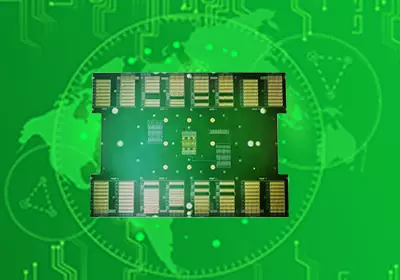
With the rapid advancement of Artificial Intelligence (AI) technology, AI servers—serving as the critical infrastructure supporting these operations—are gradually becoming a focal point of industry attention. Consequently, AI server PCBs (Printed Circuit Boards), as the core components of these systems, are also receiving increasing emphasis. Compared to standard server PCBs, AI server PCBs feature comprehensive upgrades across signal speeds, layer counts, materials, thermal management, and reliability; they represent a quintessential category of products characterized by high layer counts, high frequency and speed capabilities, high density, and high reliability.
The explosive growth in demand for AI servers, coupled with the intensive launch of new consumer electronics products, has imposed increasingly stringent requirements on the performance of PCBs—specifically regarding high-speed, high-frequency, and high-density capabilities. This shift is accelerating the evolution of the PCB industry chain, driving it away from generic manufacturing toward segments with higher technological added value; in this context, the criticality of core raw materials and high-end manufacturing equipment is becoming increasingly evident.
Technological upgrades and the iterative evolution of end products directly translate into heightened demand for upstream core materials—such as high-end copper-clad laminates, specialized copper foils, and electronic-grade resins. The performance characteristics of these materials ultimately determine the upper limits of a PCB's capabilities; furthermore, their supply landscape and associated technical barriers constitute vital links within the industry chain. Concurrently, to accommodate increasingly intricate circuitry and higher layer counts, the requirements for PCB manufacturing equipment—specifically regarding precision and efficiency—have risen in tandem. Consequently, the localization of specialized manufacturing equipment has emerged as a key indicator for assessing the industry chain's capacity for independent control and self-sufficiency.
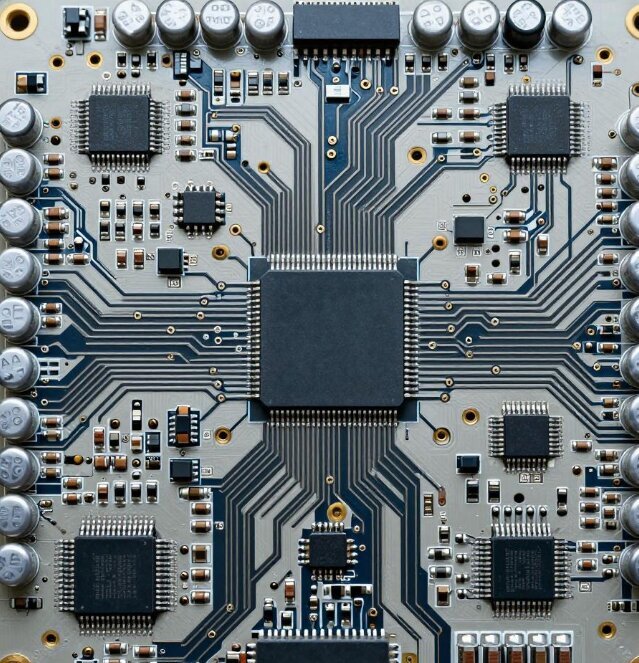
ai server pcb
Definition and Function of AI Server PCBs
An AI server PCB—specifically, a printed circuit board designed for use in artificial intelligence servers—stands as one of the core components of such systems. It serves as the platform for mounting critical electronic components—such as processors, memory modules, and network interfaces—and provides a stable physical layer to facilitate signal transmission among these components. More specifically, the functions of an AI server PCB can be broadly categorized into the following aspects:
1. Signal Transmission
The circuit routing on a PCB functions much like a city's transportation network, determining the efficiency of information flow among critical components such as processors and memory modules. Meticulously designed routing minimizes signal interference and latency, ensuring unimpeded data transmission and thereby significantly boosting the AI server's computational speed and responsiveness.
2. Structural Support and Component Mounting
The AI server PCB serves as the foundational bedrock of the entire system; it not only provides physical structural support but also acts as the mounting platform for all critical electronic components. Much like the bricks and mortar of a high-rise building, these components require a solid, stable foundation to ensure they can operate reliably and consistently across a wide range of complex working environments. The design of AI server PCBs is highly intricate; they are engineered to accommodate and securely anchor these components, thereby enabling the entire system to operate continuously and efficiently.
3. Heat Dissipation and Power Consumption
With the rapid advancement of AI technology, the power consumption of the chips housed within servers is constantly on the rise. High power consumption translates to significant heat generation, and high-temperature environments pose a direct threat to both the lifespan and stability of electronic components. Consequently, superior PCB design must prioritize not only performance but also effective heat dissipation. Through intelligent component placement and thermal design strategies, the PCB can effectively mitigate the server's thermal management challenges—all while maintaining optimal performance—thereby ensuring the system remains stable even under high-temperature conditions and enhancing its overall stability and reliability.
4. Scalability and Upgradeability
AI technology evolves at a breakneck pace, with new processors and storage solutions emerging constantly. To remain adaptable to future requirements, PCB designs must incorporate robust scalability and upgradeability features. By reserving specific interfaces and physical space, servers can facilitate the easy addition or replacement of components; this extends the system's operational lifespan and ensures it consistently maintains a high-performance state to support evolving business needs.
Current Trends in AI Server PCB Development
Currently, the primary focus of R&D for AI server PCBs lies in meeting the rigorous demands that modern AI workloads place on high power delivery, efficient thermal management, and signal integrity. Leading PCB manufacturers are actively working to advance High-Density Interconnect (HDI) and multi-layer PCB technologies. Furthermore, they are adopting advanced materials—such as low-loss substrates, high-Tg (glass transition temperature) laminates, and embedded components—to facilitate high-speed data transmission and high-current power delivery for GPU/TPU clusters.
Additionally, researchers are dedicated to refining thermal management solutions, optimizing signal integrity for high-speed serial links (e.g., PCIe 5.0/6.0, CXL), and enhancing PCB reliability during continuous AI training cycles. Collaborative R&D efforts among PCB manufacturers, semiconductor suppliers, and AI server OEMs are driving a transformative shift—moving away from traditional server circuit boards toward high-performance, high-bandwidth, and high-power-density PCB solutions—in order to satisfy the ever-growing computational demands of AI data centers.
AI servers require support for high-speed computing and massive bandwidth data transmission; this imposes stringent requirements on PCBs, specifically demanding high layer counts, exceptional signal integrity for high-speed signals, and the use of low-loss materials—such as high-frequency, high-speed substrates characterized by ultra-low dielectric constants (Dk) and low dissipation factors (Df). This presents growth opportunities for advanced PCBs (HDI, SLP, mSAP, and Any-Layer Interconnect).
AI server PCBs are not merely simple "circuit boards," but rather high-speed interconnect platforms that underpin trillions of operations per second. Understanding their core characteristics is the first lesson in entering the realm of high-end computing hardware.