A Trustworthy PCB and Electronic Manufacturing Enterprise! Contact Us


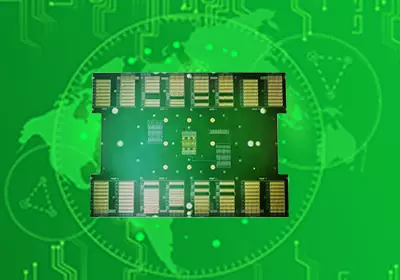
An etched circuit board refers to a manufacturing process that utilizes chemical corrosion or physical stripping to selectively remove the copper foil on the surface of a PCB substrate that is not protected by a solder mask (or photoresist), thereby preserving the protected areas to form the actual electrical circuitry. Unlike pattern transfer(which defines the circuit layout) or solder mask application (which protects the circuitry), etching is the critical step that materializes the circuit lines—while pattern transfer merely leaves a circuit outline on the copper foil surface, etching employs a subtractive process to transform that outline into physical, tangible circuit traces.
Types of Etched Circuit Boards
Each PCB etching process possesses its own distinct advantages, varying based on factors such as speed, precision, and cost. Selecting the appropriate method is essential for ensuring the quality and reliability of the circuit board.
1. Chemical Etching
This is the most common etching process employed by many PCB manufacturers. Ferric chloride solution is an excellent choice, as it is both affordable and simple to use. Ammonium persulfate serves as another viable alternative, offering faster etching speeds and a reduced environmental impact. If your application requires more precise copper etching on the PCB, copper chloride is typically the preferred option.
2. Plasma Etching
This is a dry etching technique that utilizes ionized gases to effectively remove copper. It offers exceptional precision and is ideally suited for high-tech PCBs. Reactive Ion Etching (RIE) employs oxygen and fluorine gases to selectively etch copper. Ion Beam Etching (IBE)—a form of plasma etching—utilizes a focused ion beam to remove copper material.
3. Laser Etching
This technique is fast, efficient, and well-suited for prototyping and small-batch production. CO2 laser etching is a method that employs a specialized PCB laser etching machine to rapidly vaporize unwanted copper from the board's surface. For specific PCB etching applications, Neodymium-doped Yttrium Aluminum Garnet (Nd:YAG) lasers may also be utilized.
4. Photochemical Etching
This is a process in which photosensitive materials are used to create the circuit pattern before the actual etching begins. Dry film photoresist etching involves applying a protective film to the PCB surface to shield specific areas while a chemical solution removes the exposed, unprotected copper. Conversely, liquid photoresist etching involves applying a liquid coating that solidifies upon exposure to ultraviolet (UV) light; the softer, unhardened sections of the coating are then dissolved away before the acid etching process of the PCB commences.
Etched Circuit Board Process Flow
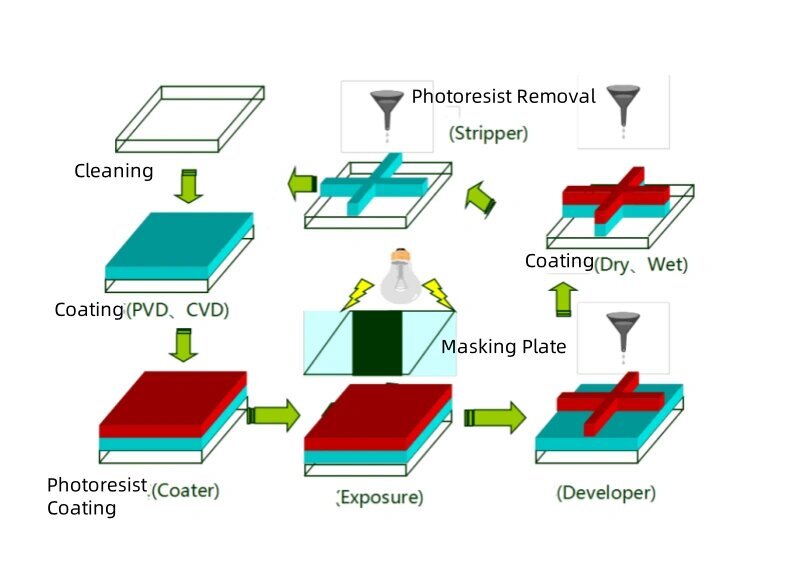
Etched circuit board
The manufacturing process for etched circuit boards typically involves the following key steps:
Circuit Design
Professional EDA software (such as Altium Designer, KiCad, etc.) is used to design the circuit schematics and perform PCB layout and routing. This step determines the circuit board's performance, dimensions, and structure.
Pattern Transfer
The designed circuit pattern is transferred onto a copper-clad laminate. Common methods include:
Photosensitive Method (Photolithography)
Thermal Transfer Method
Screen Printing Method
Exposure and Development (for Photolithography)
On the copper board covered with photosensitive material, exposure to ultraviolet (UV) light causes a chemical reaction in the areas corresponding to the circuit pattern. Subsequently, the board undergoes development to remove the unexposed (or exposed) sections, thereby forming the protective layer pattern.
Etching
Pour your chosen etching solution into a plastic tray.
Place the circuit board into the solution, ensuring the copper side faces upward.
Allow the solution to flow continuously over the circuit board. Gradually, the copper will begin to dissolve, leaving behind only the protected circuit traces.
Once all the copper has dissolved, rinse the circuit board with clean water and clean it thoroughly.
Cleaning and Finishing
Use acetone or alcohol to remove the toner; however, if the solvent concentration is too low, it may fail to remove the toner. In such cases, please use sandpaper instead.
You may now apply an additional layer of solder mask to the PCB to prevent the copper traces from oxidizing.
Drilling and Plating (If Required)
Drilling is performed on multi-layer boards or boards intended for through-hole components; plating is then applied to create conductive vias (through-holes).
Post-Processing
This includes applying the solder mask, screen-printing component legends (silkscreen), and performing surface finishes (such as HASL/tin-plating, ENIG/immersion gold, etc.) to enhance the circuit board's solderability and durability.
PCB etching is a critical step in circuit board manufacturing, essential for achieving precise electrical connections in electronic products. Whether you choose chemical etching, laser PCB etching, or DIY etched circuit board, selecting the right method and equipment ensures high-quality PCB results.
If you are looking for professional PCB etching services, iPCB provides precise etched circuit board solutions for all types of PCBs, ensuring that every single circuit board we produce meets the highest standards of accuracy and reliability.