A Trustworthy PCB and Electronic Manufacturing Enterprise! Contact Us


A universal circuit board, also known as a prototype PCB, is a universal circuit board used to build and test electronic circuits before full-scale production. Unlike a custom PCB, it offers a flexible layout with holes or solder points that allow you to easily connect and arrange components as needed.
Universal circuit boards are widely used in various electronic devices, including mobile phones, televisions, computers, etc. It is one of the key components for connecting and supporting electronic components. A universal circuit board has layers of wires and electronic components; the connections between these wires and components enable the transmission and control of signals in the circuit. universal circuit boards are manufactured using advanced processes and technologies to ensure their quality and reliability.
Universal circuit boards vs. Traditional PCBs
Universal circuit boards: Offer blank, flexible layouts with no pre-defined traces.
Used for testing, experimentation, and debugging. No design files or manufacturing required—plug and play.
Often used by hobbyists, students, and engineers in the R&D process.
Traditional PCBs: Custom designs for specific products or purposes.
Features: Etched copper traces and defined component placement.
Schematic design, layout software, and manufacturing are required.
For mass production or when the design is finalized.
This makes it suitable for early prototyping.
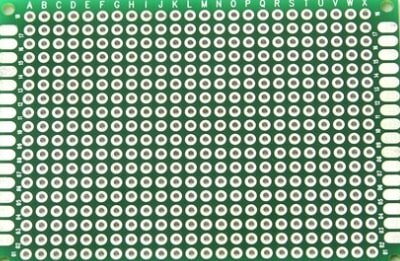
universal circuit board
Typical Applications of General-Purpose Circuit Boards
1. Product Development and Prototyping Stage
In the early stages of product development, requirements often change frequently. Directly designing and prototyping PCBs at this stage is costly and time-consuming. General-purpose circuit boards can help engineers:
Quickly verify circuit principles
Adjust parameters and structure
Reduce trial-and-error costs
2. Education, Training, and Laboratories
In teaching and training, general-purpose circuit boards are almost a "standard tool":
Students can intuitively understand circuit structures
Facilitate the development of soldering and troubleshooting skills
Controllable experimental costs and high reusability
3. Small-Batch or Non-Standard Projects
For some:
Internal testing equipment
Temporary functional modules
One-off or low-quantity projects
Using customized PCBs is not economical, making general-purpose circuit boards a more realistic choice.
Advantages of Universal Circuit Boards
The long-term existence and widespread use of universal circuit boards are inseparable from their significant advantages:
Fast development speed: No waiting time for PCB design and manufacturing
Low cost: Low unit price, suitable for small-scale use
High flexibility: Modification and adjustment are very convenient
High versatility: One board can support multiple circuits
For engineers, universal circuit boards are more like a "circuit experimentation platform."
Limitations and Challenges of Universal Circuit Boards
Of course, universal circuit boards are not a panacea, and their limitations are also very obvious:
Unsuitable for high-speed, high-frequency, and high-density circuits
Limited electrical performance and consistency
Weak anti-interference capability
Unfavorable for product appearance and structural design
When a product enters a stable stage or needs mass production, customized PCBs are almost inevitable.
Whether you are designing new equipment, testing circuits, or simply understanding how things work, universal PCBs can help you quickly test your ideas without investing in full-scale production operations. Universal circuit board is the first choice for engineers, students, and hobbyists who want to build smarter systems from the start.