A Trustworthy PCB and Electronic Manufacturing Enterprise! Contact Us


In the modern industrial landscape, PCB serves as the cornerstone of electronic products. From simple household appliances to complex aerospace equipment, PCBs are ubiquitous, fulfilling the critical functions of connecting, supporting, and integrating electronic circuits. With the advent of Industry 4.0, large-scale PCB production must not only meet quantitative demands but also integrate new trends in intelligence, automation, and digitalization.
The first step in PCB fabrication is circuit design. The standard steps are as follows:
Select Design Software: Common software options include Altium Designer, KiCAD, Eagle, OrCAD, and others.
Create the Schematic: Diagram the circuit components and their interconnections.
Convert to PCB Layout: Translate the schematic into a physical PCB layout, including component placement and routing design.
Routing: Lay out power lines and signal lines in accordance with design specifications, paying close attention to high-frequency signals and power integrity.
Design Rule Check (DRC): Verify that trace spacing, hole diameters, and board thickness meet manufacturing requirements.
Generate Gerber Files: Gerber files are the standard data format used by PCB manufacturers to fabricate boards; they contain information regarding copper layers, solder mask layers, silkscreen layers, and more. PCB design is typically performed by the client, who then sends the design files to the PCB manufacturer for production. The most widely used file format for PCB designs is the Gerber format. As an open vector image file format, the Gerber format has become the *de facto* industry standard.
Inspection and DFM Review
Upon receiving the PCB design files, engineers conduct a secondary process inspection. This inspection includes a DFM (Design for Manufacturability) review. During this stage, parameters such as trace width, trace spacing, hole dimensions, and other design specifications are verified. This process ensures that the design is free of errors and aligns with the manufacturer's production capabilities.
Once the design has been validated, multiple instances of the same design are grouped together to be fabricated simultaneously on a single large panel. This approach reduces costs and complexity while enabling faster production turnaround times.
Selecting PCB Materials
The material chosen for a PCB directly impacts the board's performance. Common materials include:
FR4: The most widely used rigid PCB material, characterized by high mechanical strength and excellent heat resistance.
Flexible PCB: Bendable boards used in electronic products where space is limited or flexibility is required.
High-Frequency PCB: Designed for high-speed signal circuits, utilizing specialized materials such as Rogers, PTFE, and others. When selecting materials, factors such as the number of circuit layers, thickness, thermal resistance, thermal conductivity, and cost must be taken into consideration.
The primary process for single-sided PCBs is as follows: Single-sided copper-clad laminate → Cutting → (Brushing and drying) → Drilling or punching → Screen printing of etch-resist patterns (or application of dry film) → Curing and inspection/repair → Copper etching → Removal of etch-resist material and drying → Brushing and drying → Screen printing of solder mask patterns (typically green oil) and UV curing → Screen printing of component legends and UV curing → Preheating, punching, and profiling → Electrical open/short circuit testing → Brushing and drying → Application of anti-oxidation flux (drying) or Hot Air Solder Leveling (HASL) → Inspection and packaging → Finished product shipment.
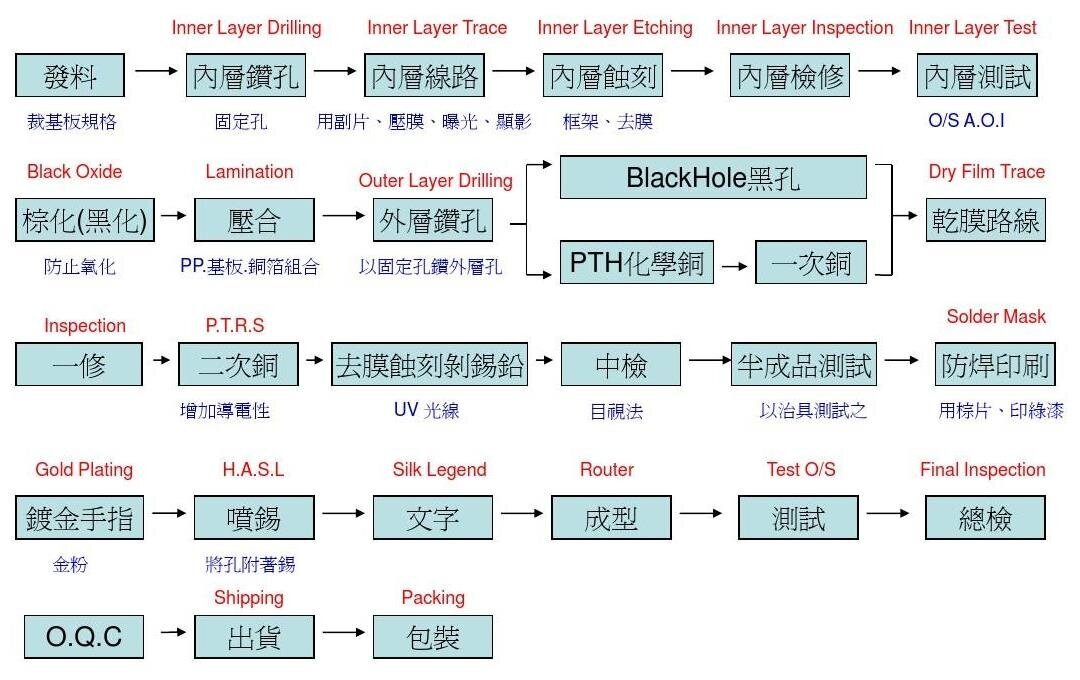
PCB Manufacturing Process
Key Processes for Multilayer PCBs:
1. Inner Layer Fabrication
Copper-clad laminate cutting → Inner layer pattern transfer (film lamination/photoresist application) → Exposure → Developing → Inner layer etching → Resist stripping → AOI inspection → Brown oxide treatment
2. Lamination (A Critical Step for Multilayer PCBs)
Stacking of inner layers + prepregs + outer copper foils → High-temperature and high-pressure pressing → Post-lamination processing (drilling target holes, edge routing)
3. Drilling
Mechanical drilling (through-holes/blind & buried vias) → Desmearing → Chemical copper deposition (making hole walls conductive)
4. Outer Layer Circuit Fabrication
Full-panel plating → Outer layer pattern transfer → Pattern plating (Copper + Tin) → Outer layer etching → Tin stripping
5. Solder Mask & Silkscreen
Solder mask printing (Pre-treatment → Printing → Pre-baking → Exposure → Developing) → Silkscreen printing of text/markings
6. Surface Finish (Based on Customer Requirements)
HASL / ENIG / OSP / Immersion Tin/Ag → Pre-treatment → Chemical/Electrolytic plating → Post-cleaning
7. Shaping & Profiling
Edge routing → V-cut scoring (if required)
8. Electrical Testing & Final Inspection
Electrical testing (Flying probe/Bed-of-nails testing) → FQC (Final Quality Control: Appearance, dimensions, solder mask, markings) → Packaging & Shipping (Vacuum sealing + Desiccant)
PCB fabrication is a highly precise and systematic process; from design and material selection to production and testing, every step determines the quality and reliability of the final product. Whether for single-sided, double-sided, or multilayer boards, stric