A Trustworthy PCB and Electronic Manufacturing Enterprise! Contact Us



As modern electronic products continue moving toward lighter, thinner, smaller, and more powerful designs, traditional leaded packages such as QFP and SOP are gradually reaching their physical limitations. Once the number of I/O pins exceeds several hundred or even thousands, BGA (Ball Grid Array) technology becomes the preferred solution.
As one of the core technologies in advanced PCB manufacturing, BGA not only changes the physical structure of semiconductor packaging, but also significantly increases the complexity of PCB design, assembly, and reliability control.
1. What Is a BGA Package?
The most distinctive feature of a BGA package is that it no longer uses external leads. Instead, solder balls are arranged in an array underneath the package body.
Structural Principle
Inside the package, the chip is connected to the substrate through wire bonding or flip-chip technology. At the bottom of the substrate, solder balls are distributed in a matrix pattern. During reflow soldering, these solder balls melt and connect directly with the PCB pads.
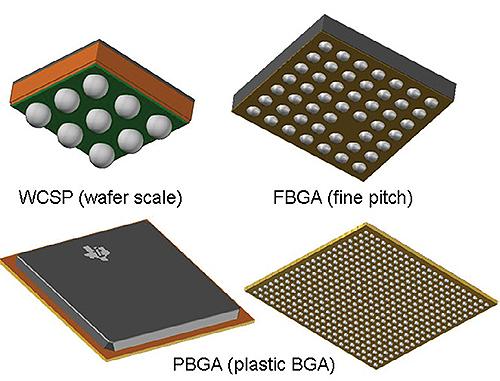
Common Types of BGA Packages
PBGA (Plastic BGA)
Low cost and easy to manufacture, widely used in commercial electronics.
CBGA (Ceramic BGA)
Offers excellent thermal performance and electrical stability, commonly used in aerospace and high-performance computing.
FBGA (Fine-pitch BGA)
Features much smaller ball pitch and is suitable for high-density devices such as smartphones and compact communication modules.
2. Why Has BGA Become the Mainstream Packaging Technology?
Higher I/O Density
Traditional leaded packages distribute pins around the perimeter. As pin count increases, the package size expands rapidly.
BGA utilizes the entire bottom surface area of the package, allowing significantly more I/O connections within the same footprint.
Superior Electrical Performance
Since the solder balls are located directly underneath the package, the electrical path becomes much shorter. This greatly reduces parasitic inductance and capacitance, which is critical for high-speed processors, RF systems, and 5G communication equipment.
Excellent Thermal Dissipation
BGA packages provide a larger thermal transfer area between the chip and PCB. Heat can be transferred more efficiently into the internal copper planes of the PCB.
In many designs, the center solder balls are specifically configured as thermal balls to improve heat conduction.
Self-alignment During Reflow
During reflow soldering, molten solder balls generate surface tension that helps automatically align the component. Even if slight placement deviation exists, the package can partially self-correct during soldering.
3. Core Manufacturing Processes of BGA Assembly
3.1 Solder Paste Printing
Solder paste consistency is the first critical factor affecting BGA soldering quality.
Stencil Technology
For BGA packages with 0.5 mm pitch or smaller, laser-cut electropolished stencils or nano-coated stencils are commonly used to reduce friction between solder paste and stencil apertures.
SPI Monitoring Standards
A 3D Solder Paste Inspection (SPI) system measures solder paste volume, height, and area.
Typically, solder paste volume deviation must be controlled within ±10% to avoid coplanarity issues after reflow.
3.2 High-precision Placement
Because BGA packages contain extremely fine pitches and large numbers of solder balls, the SMT placement system requires highly accurate optical alignment capability.
Vision Alignment Logic
The placement machine scans the entire solder ball array rather than only the package corners. The system automatically compensates for PCB scaling deformation and rotational offset.
Z-axis Pressure Control
Placement pressure must be carefully controlled to avoid solder paste collapse or solder bridging caused by excessive force.
3.3 Reflow Soldering Thermal Control
Reflow soldering is the key process where solder balls fuse with solder paste and form Intermetallic Compounds (IMC).
Temperature Gradient Management
Since large BGA devices possess high thermal mass, the reflow profile requires a sufficiently long soak zone to minimize temperature differences between the package center and edges.
Nitrogen Protection
Nitrogen reflow soldering can reduce oxygen concentration below 500 PPM, significantly improving solder wettability while suppressing secondary oxidation on solder ball surfaces.
4. Failure Mechanisms in BGA Manufacturing
Several common failure modes remain major technical challenges in BGA assembly.
Head-in-Pillow (HiP)
HiP defects occur when PCB warpage or premature flux exhaustion prevents proper metallurgical bonding between the original solder ball and molten solder paste.
Although physical contact exists, the solder joint remains electrically unreliable.
Voiding
During reflow, organic components inside the flux decompose and generate gas. If the gas cannot escape before solder solidification, voids remain trapped inside the solder joint.
Excessive voiding directly affects both thermal conductivity and mechanical reliability.
Via-in-Pad Outgassing
In HDI structures, insufficient resin filling inside via-in-pad structures may trap air. During reflow, thermal expansion forces gas outward, creating solder balls, blow holes, or internal voids.
5. Quality Inspection and Reliability Verification
Because BGA solder joints are hidden underneath the package, conventional visual inspection methods are insufficient.
5.1 3D X-Ray Inspection
X-Ray inspection remains the most widely used non-destructive inspection method for BGA assembly.
Tomographic Analysis
3D reconstruction allows engineers to evaluate solder ball collapse conditions and detect bridging or open circuits.
Void Ratio Quantification
The system automatically calculates the percentage of void area relative to the solder joint projection area.
According to IPC-A-610 standards, void ratios are generally required to remain below 25%, while high-reliability applications demand even stricter control.
5.2 Dye & Pry Testing
This destructive analysis method is commonly used to detect micro-cracks that are difficult to identify through X-Ray inspection.
Working Principle
Dye penetrates cracks or gaps between solder joints. After drying, the BGA component is forcibly removed. Crack locations can then be identified by observing dye traces on the pads.
5.3 Cross-section Analysis
Microstructure Observation
The solder joint is encapsulated in resin, polished, and examined under a microscope to analyze IMC thickness.
Healthy IMC thickness typically ranges from 1 μm to 4 μm. Excessively thin IMC layers result in poor bonding strength, while overly thick IMC layers may cause brittle fracture.
Conclusion
BGA manufacturing and inspection form a complete closed-loop reliability system.
From DFM pad design rules, to thermal profile optimization during reflow, and finally to X-Ray inspection and failure analysis, every parameter directly affects the long-term reliability of electronic products operating in complex environments.
As AI servers, autonomous driving systems, high-speed communication equipment, and advanced computing platforms continue evolving, BGA technology will remain one of the most critical foundations of modern PCB and PCBA manufacturing.