A Trustworthy PCB and Electronic Manufacturing Enterprise! Contact Us



An HVAC circuit board is the control unit that keeps a heating, ventilation or air conditioning system running the way the user expects. Often called an HVAC control board, it reads sensors, switches loads and protects the equipment when something goes wrong. This guide covers what these boards do, the types you will meet, and the design and manufacturing points that decide whether a board survives years of heat, humidity and vibration.
Inside every air conditioner, furnace, heat pump or ventilation unit there is a small group of boards doing quiet but critical work. They decide when the compressor starts, how fast the fan turns, when the heater switches off and what happens if a pressure switch trips. Most of these boards are built from standard PCB manufacturing processes, but the working conditions are harsher than in an ordinary consumer product, so the specification needs more thought than a typical two-layer board.
Many buyers first meet this product through a repair or replacement project. Someone has an old control board, a drawing or a sample, and needs to reproduce it reliably. In that case the choice of PCB assembly partner matters as much as the layout, because relays, transformers and connectors need careful soldering and inspection.
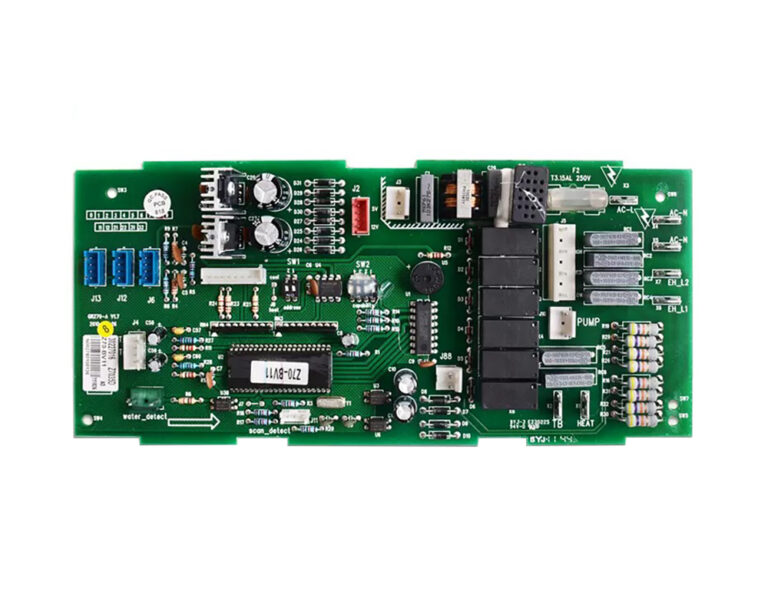
What an HVAC Control Board Actually Does
The board takes in information and turns it into action. Typical inputs are temperature sensors, humidity sensors, pressure switches, flame or ignition signals, and commands from a thermostat or remote. The outputs are relays, triac drivers or power stages that run the compressor, blower, reversing valve, heating element, pump and damper motors.
Beyond basic switching, a modern board handles several other jobs. It runs safety logic such as overcurrent, overvoltage, phase loss, freeze protection and high or low pressure cut-out. It reports faults through LED blink codes or a display. And it communicates, either between indoor and outdoor units or with a building system through protocols such as RS-485 or Modbus, and increasingly through Wi-Fi modules.
Common Types of HVAC Boards
A single product often contains several boards, each with its own job.
Main control board. This is the central board. It holds the microcontroller, the relays and the connectors for sensors and loads. In many North American systems it works at 24 V AC for the control side and switches higher-voltage loads through relays.
Inverter or motor drive board. Variable-speed compressors and fans use a drive board that converts mains power into a controlled output. These boards carry high currents and generate heat, so layout and copper weight are critical.
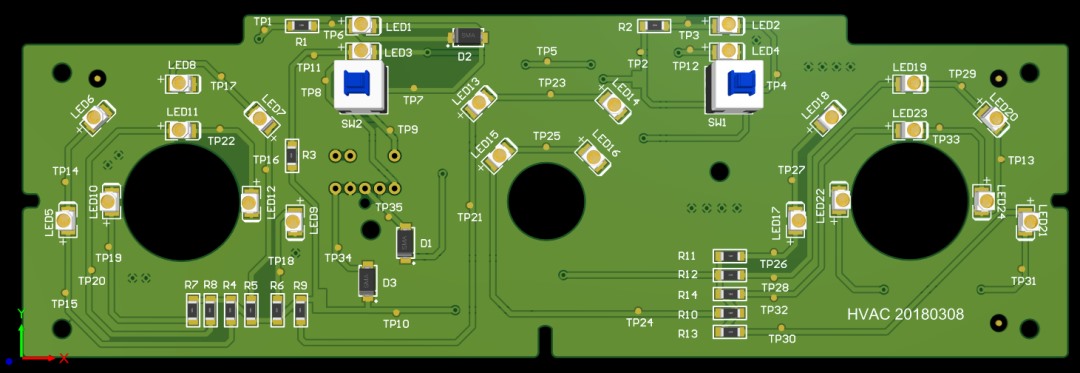
Display and keypad board. This is the user interface, with buttons, LEDs or a screen. It is low power but must match the housing precisely.Interface and relay board. Some designs separate the relays and terminals from the logic, which simplifies service and certification.Sensor board. Small boards that carry thermistors or pressure sensors and sit near the coil, duct or compressor.
Design Points That Matter Most
Mixed high and low voltage. An HVAC circuit board usually has mains-level circuits next to low-voltage logic. Creepage and clearance distances must be respected, and many designs cut slots in the board to increase the surface path between the two areas. These distances depend on the working voltage and the pollution degree of the environment, so check them against the safety standard that applies to your product, not against a general rule of thumb.
Copper thickness. Relay contacts, compressor feeds and heater lines can carry several amps or more. Standard 1 oz copper is often not enough, and 2 oz or heavier copper is common on these boards. Thicker copper also spreads heat, though it makes fine-pitch etching harder, so keep small signal traces and large power paths in mind when the stack-up is chosen. Wider traces, copper pours and thermal relief around heavy pads help keep temperature rise under control.
Relays and connectors. Relays are heavy and generate heat, and their coils create voltage spikes. Place flyback diodes or snubbers correctly, and give the contact traces enough width. Connectors take mechanical stress every time a technician plugs in a harness, so use through-hole mounting or reinforced pads, and add strain relief where cables pull on the board.
Noise and signal quality. Compressor motors and switching power stages create electrical noise. Keep sensor traces short, route them away from power switching, and use a solid ground reference. A temperature reading that jumps because of noise can trigger false protection and drive a service call.
Thermal planning. Power components such as triacs, IGBTs, MOSFETs and bridge rectifiers heat up. Use copper area, thermal vias and, where needed, heat sinks. Leave space between hot parts and electrolytic capacitors, since heat shortens capacitor life more than almost anything else.
Choosing Materials for Harsh Conditions
HVAC equipment lives in tough places: attics, rooftops, outdoor condensers, basements and machine rooms. The board must tolerate heat, moisture, dust and sometimes corrosive air.
Base material. FR-4 is the standard choice. For boards that run hot, a higher glass transition temperature grade such as TG150 gives better stability. Cost-sensitive appliances sometimes use CEM-1 or CEM-3 single-sided or double-sided boards, which are cheaper but offer less strength and less hole reliability, so they suit simpler, lower-power designs.
Flame rating. Most products require a UL 94V-0 rated laminate. Ask the supplier for the material certificate and make sure the board marking matches your safety documentation.
Surface finish. Lead-free HASL is economical for many appliance boards. ENIG gives a flatter surface for fine-pitch parts and better shelf life. OSP is cheap and flat, but it is sensitive to repeated heating and long storage, so confirm it fits your assembly flow.
Protection. Conformal coating is common on HVAC boards because condensation and dust are constant threats. A thin acrylic or silicone coating protects against moisture and leakage between close conductors. Plan for it in the design, since connectors, test points and relay vents must be masked, and some components need clearance for the coating process.
Safety and Compliance
Because an HVAC circuit board is part of mains-powered equipment, compliance is not optional. Typical requirements include recognized laminate and board ratings, spacing that meets the applicable safety standard, and RoHS-compliant materials. Markets differ: North America, Europe and other regions each have their own approvals, and the board is only one part of the product certification. Tell your fabricator which standards the end product must meet, so the right laminate and marking are used from the start.
Manufacturing and Assembly Notes
Panelization. Appliance boards are often produced in large volumes at low unit prices, so panel utilization has a direct effect on cost. Share the board outline early so the fabricator can propose an efficient panel, and decide whether you want V-cut, tab routing or a mix. Heavy through-hole parts near the edge may need extra support during depanelling.
Mixed assembly. Most HVAC boards combine surface-mount parts with through-hole relays, transformers, terminals and capacitors. This normally means reflow for the small parts and wave or selective soldering for the large ones. Place heavy components so they do not interfere with the wave, and keep surface-mount parts off the wave side where possible.
Inspection and testing. Automated optical inspection catches many solder defects. For safety-critical boards, add functional testing, with the board powered and loaded to simulate real operation, and consider high-voltage insulation testing where the design requires it. A board that passes visual inspection may still have a marginal joint on a heavy relay pin, so burn-in or thermal cycling samples are worth considering for new designs.
Traceability. Date codes, lot numbers and serial marks help a manufacturer find affected units quickly if a component batch proves faulty. Agree on what to mark and where before production, because space on the board and on the silkscreen is limited.
Reliability Problems to Avoid
Experience from the field shows the same few issues again and again.Cracked solder joints at relays and transformers, caused by weight and thermal cycling. Larger pads, correct hole sizes and good wetting reduce the risk.Burnt traces or discolored areas near power paths, caused by too little copper or poor thermal design.Corrosion and leakage between close pads, caused by humidity, flux residue or missing coating.Premature capacitor failure, caused by heat from nearby components.Intermittent faults from poorly seated connectors or damaged harness terminals.Most of these are preventable during design review, so ask your supplier to check the layout for manufacturability before production starts.
How to Prepare an Accurate Quote Request
A clear request saves days of back and forth. Send the Gerber files or ODB++ data, the bill of materials with approved alternatives, the assembly drawing, the stack-up and copper thickness, the base material and flame rating, the surface finish, solder mask color, conformal coating requirements, any certification marks, test requirements and the expected quantity per order and per year. If you are replacing an existing board, send clear photos or a sample so the team can confirm dimensions, hole sizes and component positions.
If you are unsure about copper weight, spacing or panel layout, say so. A short engineering review before quoting often reveals savings, such as moving to a simpler laminate for a low-power board or adjusting the outline to fit more boards on a panel.
Final Thoughts
A good control board does its job unnoticed. The user feels a comfortable room, and the technician never has to open the cabinet. Getting there depends on practical decisions: enough copper, safe spacing, suitable laminate, sound soldering and a coating that matches the environment. If you are starting a new design or sourcing a replacement HVAC circuit board, send your files and requirements to our team for a review and quotation, and we will help you choose a build that fits both the application and the budget.