A Trustworthy PCB and Electronic Manufacturing Enterprise! Contact Us


The upgrade of wireless communication, radar detection, and electronic warfare systems demands higher bandwidth, stability, and anti-interference performance. As the core hardware hub of all wireless devices, the rf front end handles signal conversion, amplification, filtering and frequency tuning between radio waves and electrical signals, directly defining the overall performance of wireless equipment. Traditional electronic rf front end solutions now face unavoidable bottlenecks in high-frequency, ultra-wideband and complex electromagnetic environments, making microwave photonic technology the ideal path to upgrade classic RF front-end performance.
From mature 5G commercial deployment to ongoing 6G pre-research, wireless systems are evolving toward high frequency, ultra-wideband and low latency. Millimeter-wave and terahertz spectrums, which support massive data throughput, have become core resources for next-generation networks. However, conventional electronic RF hardware built on transistors, microstrip lines and electrical filters struggles to adapt to high-frequency operation. The microwave photonic rf front end effectively resolves the high loss, narrow bandwidth and poor anti-interference flaws of traditional designs, supporting the iterative upgrade of modern wireless systems.
Basic Working Principle and Core Value of RF Front End
To understand photonic RF front-end advantages, it is essential to grasp the basic logic of the traditional rf front end. Serving as the bridge between antennas and baseband/intermediate frequency units, this component is indispensable for mobile terminals, base stations, satellites and radar systems. Its core functions rely on two independent yet coordinated links: the transmit chain and the receive chain, enabling bidirectional wireless signal processing.
In the transmit chain, low-frequency baseband signals are modulated and up-converted to intermediate frequency signals. The rf front end further up-converts these signals to high-frequency RF bands, amplifies power, filters out clutter, and delivers purified signals to the antenna for wireless radiation. This process transforms weak low-frequency electrical signals into high-power, transmissible radio waves for long-distance wireless transmission.
The receive chain performs the reverse process. The antenna captures faint spatial radio waves, and the rf front end filters out out-of-band interference, amplifies weak signals via low-noise modules, and down-converts high-frequency RF signals to intermediate or baseband signals. The processed low-frequency signals are then sent to baseband chips for demodulation and digital analysis, completing signal reception and decoding.
Unlike low-frequency baseband signals (original data that cannot transmit wirelessly) and fixed intermediate frequency signals (simplifying circuit design), RF signals processed by front-end systems range from 300 MHz to tens of GHz. These high-frequency signals support efficient antenna radiation and reception, serving as the core transmission carrier for wireless communication.
In short, the rf front end builds a stable transceiving channel for wireless devices. Key device metrics including signal coverage, transmission speed, reception sensitivity and anti-interference capability are all determined by front-end performance, making it the foundational hardware of all wireless and radar systems.
Core Components of Traditional RF Front End
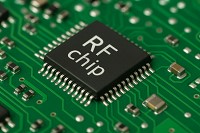
The traditional electronic rf front end consists of six functional modules with clear division of labor, working together to complete full-link signal processing and determine overall system performance.
The Power Amplifier (PA) is the core of the transmit chain. It amplifies low-power RF signals dozens to hundreds of times to provide sufficient radiation strength for long-distance transmission, directly deciding a device’s signal coverage range.
The Low-Noise Amplifier (LNA) is the key receive-chain component. It amplifies extremely weak antenna-captured signals while minimizing noise introduction, greatly improving reception sensitivity and enabling accurate signal capture in complex electromagnetic environments.
Filters act as signal screeners, selecting target frequency bands and filtering out harmonics, noise and cross-band interference. They eliminate spurious signals at the transmitting end and purify target signals at the receiving end, ensuring signal purity throughout processing.
Duplexers and RF switches control transceiving switching and signal isolation. Most wireless devices use a single antenna for both transmission and reception; these components switch antenna links rapidly and isolate strong transmit signals from weak receive signals, preventing signal crosstalk and enabling simultaneous transceiving.
Mixers and local oscillators form the frequency conversion core. They complete up-conversion (low frequency to RF band) during transmission and down-conversion (RF band to low frequency) during reception, adapting signals to subsequent circuit processing requirements.
Matching circuits ensure efficient signal transmission via impedance matching. Standard civilian wireless devices adopt 50Ω impedance; matching modules eliminate signal reflection, power loss and waveform distortion caused by impedance mismatch, maintaining stable long-term operation of the rf front end.
Technical Bottlenecks of Traditional RF Front End
Traditional electronic rf front end technology matures well for 4G and low-band 5G scenarios, but shows fatal physical limitations in millimeter-wave, terahertz and high-precision radar applications, forming six major bottlenecks that block next-generation wireless upgrades.
First, high-frequency loss is severe with low efficiency. Above 10 GHz, skin effect, dielectric loss and radiation loss cause exponential signal attenuation. A 28 GHz microstrip line has 4–6 dB/cm loss, rising to 15–20 dB/cm in the 77 GHz radar band and over 30 dB/cm in terahertz bands. Meanwhile, PA efficiency drops from 40%–50% at low frequencies to only 5%–10% at millimeter waves, leading to high power consumption and serious heat generation.
Second, instantaneous bandwidth is severely limited. Restricted by transistor cutoff frequency and parasitic parameters, traditional front ends only support 2–3 GHz instantaneous bandwidth, far below the 10–100 GHz ultra-wideband demand of 6G terahertz communication. Simple hardware optimization cannot bridge this gap, and forced bandwidth expansion leads to larger device size, higher power consumption and cost.
Industry standards reveal obvious bandwidth hierarchies across frequency bands. Based on the Shannon-Hartley theorem and the 5% center-frequency bandwidth rule, 4G low bands support only 20 MHz single-carrier bandwidth, 5G Sub-6 GHz bands support 100 MHz, and millimeter-wave bands reach 400 MHz (2 GHz with carrier aggregation). Traditional rf front end hardware cannot adapt to terahertz ultra-wideband scenarios.
Third, anti-interference ability and transceiving isolation are insufficient. Electronic signal transmission via metal conductors is vulnerable to external electromagnetic interference. Traditional duplexers only provide 20–30 dB isolation, dropping to 15–25 dB at millimeter waves. In complex industrial, high-speed rail or battlefield environments, crosstalk easily drowns weak target signals, raising bit error rates and causing communication interruptions or radar false alarms.
Fourth, reconfigurability is poor. Traditional front ends adopt fixed hardware designs, requiring independent components for different frequency bands. Cross-band switching relies on mechanical modules with 1–10 ms delay and 3–6 dB loss, failing to adapt to dynamic spectrum access and multi-standard fusion scenarios.
Fifth, dynamic range and phase stability fail high-precision requirements. Severe nonlinear distortion limits the spurious-free dynamic range to 60–80 dB·Hz^(2/3). Temperature and vibration cause component parameter drift, leading to large phase jitter and low frequency stability (10⁻¹² to 10⁻¹⁴), unable to support deep-space communication and distributed radar systems.
Sixth, traditional front ends feature large size, heavy weight, high power consumption and high cost. Discrete components, complex PCB layouts and heat dissipation modules make 5G multi-band front ends bulky and power-hungry, limiting miniaturized deployment on drones, satellites and portable terminals.
Microwave Photonic RF Front End: Breaking Electronic Hardware Limits
The core difference between a microwave photonic rf front end and traditional electronic front ends lies in signal processing carriers and architecture. Traditional systems process all signals in the electrical domain, while photonic front ends adopt a unique electro-optical-electrical conversion framework, migrating core signal processing to the optical domain and breaking electronic physical bottlenecks.
The photonic front-end workflow is highly modular and efficient. First, electro-optical modulators load RF electrical signals onto stable optical carriers. Next, the optical processing unit completes ultra-wideband filtering, frequency conversion, delay and beamforming. Finally, photodetectors convert optimized optical signals back to standard RF electrical signals, with back-end circuits finishing signal conditioning. This architecture delivers unmatched advantages over traditional electronic equipment.
Photonic systems feature inherent ultra-wideband capability, covering microwave, millimeter-wave and terahertz bands with tens of GHz instantaneous bandwidth, fully meeting 6G ultra-wideband requirements. Optical fiber transmission loss is only 0.2 dB/km, far lower than centimeter-level high-frequency loss of electronic lines, enabling ultra-low-loss long-distance transmission.
Additionally, optical signals are immune to electromagnetic interference, ensuring stable operation in harsh electromagnetic environments. The photonic rf front end supports flexible software-defined band switching without hardware replacement, improving spectrum utilization. It also provides ultra-high phase stability (10⁻¹⁷ to 10⁻¹⁹) for hundred-kilometer high-fidelity signal transmission, while integrated photonic chips reduce device volume by over 80% for lightweight, low-cost deployment.
Core Modules and Back-End Circuit Functions
A complete microwave photonic rf front end consists of five core modules: laser light source, electro-optical conversion unit, optical domain processing unit, opto-electronic conversion unit and back-end circuits, forming a closed-loop signal processing system.
The 1550 nm narrow-linewidth laser outputs low-noise, stable-frequency optical carriers for high-quality signal modulation. Dual-polarization IQ and Mach-Zehnder modulators complete high-precision electro-optical conversion with low distortion and high linearity.
As the core differentiated module, the optical domain processing unit integrates photonic filters, optical frequency combs, delay lines and optical switches, realizing all-optical ultra-wideband filtering, frequency conversion, signal storage and beamforming that electronic systems cannot achieve.
High-speed photodetectors convert processed optical signals back to RF electrical signals. The output raw signals require further optimization via back-end circuits, which include three key functions: RF amplification to boost weak signal power, filter circuits to eliminate conversion clutter and harmonics, and signal conditioning/matching circuits to fix waveform distortion and achieve impedance matching for subsequent digital sampling and processing.
Key Technologies and Industrial Breakthroughs
The performance leap of microwave photonic rf front end relies on integrated microwave-photonic technologies. Recent years have witnessed rapid breakthroughs in device optimization and algorithm iteration, solving early inherent defects of photonic systems.
Advanced electro-optical conversion technologies based on thin-film lithium niobate (TFLN) and silicon photonic chips reduce insertion loss and nonlinear distortion, improving spurious-free dynamic range by over 10 dB. Combined with digital pre-distortion algorithms, these technologies compensate signal distortion efficiently without hardware upgrades.
Photonic frequency conversion and channelization break traditional mixer bandwidth limits, supporting arbitrary frequency conversion and fine-grained channel segmentation for 220–280 GHz terahertz signals. Photonic true-time-delay beamforming eliminates beam dispersion, enabling ultra-wideband large-angle scanning for phased array radar.
Photonic RF storage realizes hundreds of microseconds high-fidelity ultra-wideband signal buffering, supporting rapid multi-false-target interference generation for radar electronic countermeasures. High-precision phase stabilization technology achieves ultra-low-jitter long-distance transmission, meeting deep-space communication and high-precision radar standards.
Early photonic front-end flaws including conversion loss, photodetector saturation and phase missing have been effectively resolved. New heterogeneous photodetectors improve saturation power, while single-sideband modulation combined with balanced coherent detection eliminates DC clutter and restores complete phase information, greatly improving system stability and fidelity.
Main Industrial Applications
With maturing technology, the microwave photonic rf front end has moved from laboratory verification to commercial pilot deployment, empowering multiple high-end wireless scenarios.
In 6G terahertz/millimeter-wave fronthaul scenarios, photonic front ends realize photonic generation and processing of 100–300 GHz ultra-wideband signals. A single optical fiber supports Tbit/s-level transmission and multi-standard (4G/5G/6G) convergence, with picosecond-level latency fluctuation, fully complying with 6G fronthaul technical indicators.
In Radio-over-Fiber (RoF) multi-service convergence scenarios, the technology integrates mobile communication, WiFi, high-speed rail private network and satellite positioning services on one fiber link. It simplifies network deployment, reduces costs, and ensures stable high-speed transmission in dense urban and high-speed mobile scenarios.
In full-duplex communication systems, integrated photonic front ends integrate self-interference cancellation, frequency conversion and local oscillator generation functions, achieving over 60 dB wide-band isolation (peak 72 dB). It doubles spectrum efficiency, solving the core bottleneck of in-band full-duplex communication and serving cellular networks and industrial IoT systems.
For satellite and deep-space communication, miniaturized photonic front ends replace bulky traditional electronic units. They support high-stability Ka/Q/V band signal transmission with 10⁻¹⁹-level frequency stability, reducing on-board equipment size and weight by over 50% and adapting to harsh space environments.
Industry Development Prospect
The evolution from 4G to 6G ultra-wideband communication is essentially a process of breaking electronic hardware limitations. Restricted by inherent physical flaws, the traditional rf front end can no longer support high-performance communication, radar and electronic warfare systems. In contrast, the microwave photonic rf front end, with ultra-wideband, low-loss, anti-interference, high-stability and reconfigurable advantages, has become the core breakthrough technology for next-generation wireless systems.
Current domestic research has achieved remarkable progress in integrated photonic chips and multi-functional front-end integration, with continuous improvements in practicability and integration. In the future, with further cost reduction and performance optimization of photonic devices, microwave photonic rf front end technology will achieve large-scale commercialization, comprehensively empowering 6G communication, intelligent radar, satellite communication and high-precision industrial wireless transmission, leading the new trend of next-generation RF hardware innovation.