A Trustworthy PCB and Electronic Manufacturing Enterprise! Contact Us


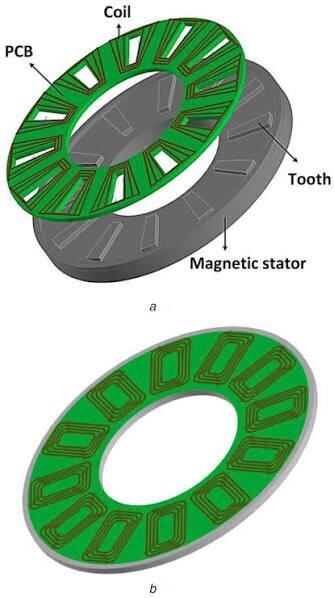
PCB motor is a general term for motors that utilize PCB technology to construct their stators. PCB-based stator windings have emerged as a viable alternative to traditional coil windings and are suitable for axial-flux motors, linear motors, and planar motors.
The manufacturing process for traditional motor stators involves four key stages: winding, coil insertion, coil encapsulation, and epoxy curing. In contrast, the design of PCB stators—including winding patterns and interlayer interconnects—is completed using EDA software; the resulting Gerber files are then sent to a PCB factory for fabrication.
PCB stator fabrication begins with etching circuit patterns onto copper-clad laminates for each layer, followed by lamination using prepreg (PP) sheets. Once lamination is complete, the process proceeds to outer-layer drilling, via plating, surface finishing, and final profiling. Leveraging the mature manufacturing processes and equipment of PCB production lines, PCB stators offer superior performance compared to traditional stators in terms of parameter consistency, surface flatness, and mechanical strength. Downstream customers can proceed directly to final assembly upon receiving the PCB stators, thereby eliminating numerous manual labor steps.
Key Advantages of PCB Motors
High Efficiency: By optimizing the design and layout of the stator windings, PCB motors achieve higher energy conversion efficiency. Compared to traditional motors, they deliver more useful work output for the same input power, significantly reducing energy consumption.
Lightweight Design: Since the stator windings are printed directly onto the PCB, the heavy iron core structures found in traditional motors are eliminated, resulting in a substantial reduction in weight. This not only enhances equipment portability but also lowers transportation and installation costs.
Low Noise: PCB motors generate minimal noise during operation, often achieving near-silent performance. This is a significant advantage for applications requiring a quiet environment.
High Reliability: The manufacturing process for PCB motors is highly automated and utilizes advanced electronic components and interconnection technologies, ensuring high reliability and a long service life. Furthermore, the tight integration between the stator windings and the PCB prevents common issues found in traditional motors, such as loose windings or poor electrical contact. Flexible Design: PCB stator motors offer exceptional design flexibility. Manufacturers can rapidly customize motor solutions with varying power ratings and dimensions to meet specific customer requirements. This flexibility enables their widespread adoption across diverse fields and scenarios.
Disadvantages of PCB Motors
Higher Manufacturing Costs: The manufacturing cost of PCB motors is more than double that of traditional motors, which limits their application in certain large-scale equipment sectors.
Complex Control Circuitry: As these motors require direct control, specialized control circuitry is necessary; consequently, operating or servicing them demands a high level of technical expertise.
Lower Torque: PCB motors generate less torque than traditional motors, restricting their use in certain applications.
In summary, PCB motors are seeing an expanding range of applications in the electronics sector, thanks to advantages such as low noise, high efficiency, high reliability, and compact size. Despite higher manufacturing costs, their long-term stable operation makes them the preferred choice for most electronics manufacturers.
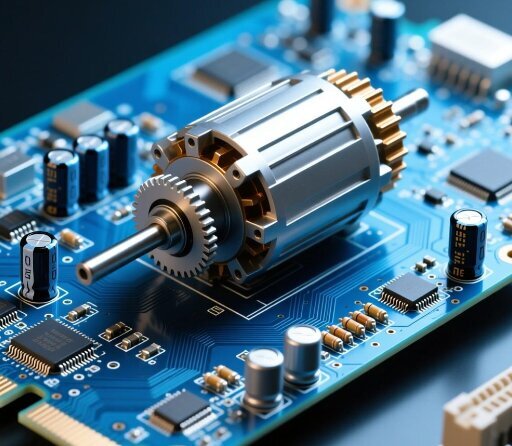
PCB motor
PCB Stator Manufacturing Process
The manufacturing advantages of PCB motors stem from the extensive expertise inherent in PCB technology. Compared to traditional winding methods, PCB stator manufacturing represents a significant leap forward:
PCB motors derive their core competitiveness from three key technologies: utilizing multi-layer PCB stacking—along with blind/buried vias and multi-layer copper foil processes—to create three-dimensional coil windings that drastically increase power density within a compact footprint, thereby laying a solid foundation for high-performance magnetic circuits; employing flexible polyimide (PI) substrates to provide the stator with excellent flexibility and high-temperature resistance, enabling installation on complex curved surfaces and operation in high-vibration environments; and utilizing thick-copper processing—with single-layer copper thicknesses reaching 3 oz or more—to deliver superior high-current carrying capacity, fully meeting the power demands of various high-power applications.
The rise of the PCB motor represents a historic convergence—spanning time and space—between a classic invention from 1831 and the technological revolution of the 21st century. Mature PCB manufacturing processes empower high-performance axial-flux architectures, redefining the future form of electric motors. Combining the core advantages of lightweight design, high efficiency, and high precision with ease of mass production, this technology represents not merely an incremental upgrade in specifications, but a fundamental shift in the motor manufacturing paradigm. For new energy vehicles pursuing ultimate energy efficiency, humanoid robots in urgent need of technological breakthroughs, and the electric aviation sector with its stringent lightweighting requirements, PCB motors are no longer just an alternative—they are the inevitable choice for industry advancement.