A Trustworthy PCB and Electronic Manufacturing Enterprise! Contact Us


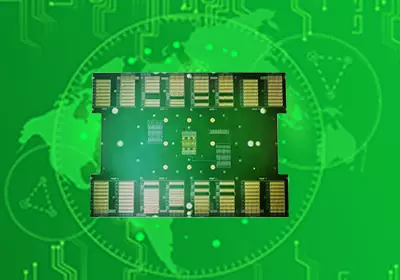
In PCB and international electronics sourcing, “ceramic cutting boards” can sometimes appear as a practical search term for ceramic PCB and ceramic substrate solutions. Unlike conventional FR-4 boards, ceramic circuit boards are engineered around the physical properties of ceramic materials, making them especially valuable where thermal performance, high frequency, mechanical stability, and long-term reliability matter.
Some engineers still hold a dangerous misconception though: they believe ceramic cutting boards are merely an "upgraded version" of standard PCBs—slightly more durable, marginally better at heat dissipation, and a premium alternative only considered when FR 4 reaches its performance limits. This misunderstanding can cost PCB manufacturers dearly in performance and reliability; in critical applications, it may even lead to total design failure. Ceramic based circuits are not simply "a better PCB"—they represent a fundamentally different technology platform. Below are eight hard truths that explain why this distinction matters.
01. FR-4 Is a Material Compromise
FR-4 remains the standard material for a huge range of electronic products because it offers a practical balance between cost, manufacturability, electrical insulation, and mechanical strength. However, its organic resin structure also creates inherent limitations.
Thermal conductivity is relatively low, mechanical properties can change at elevated temperatures, and its coefficient of thermal expansion (CTE) does not closely match that of silicon. These characteristics may be acceptable for conventional electronics, but they become increasingly important as power density, operating temperature, and signal frequency increase.
A ceramic PCB is therefore not simply a stronger version of FR-4. It represents a different material platform designed around different physical requirements.
02. Ceramics: A Fully Customizable Engineering Platform
This is where the real shift occurs: unlike conventional PCBs built from laminated layers, high thermal conductivity ceramic substrate designs are constructed on a monolithic ceramic base. Materials such as alumina (Al₂O₃), aluminum nitride (AlN), and silicon nitride (Si₃N₄) are not fillers—they form the very structure of the board, and that changes everything. Ceramic substrates offer:
1. Thermal conductivity up to 100× higher than FR‑4
2.Superior electrical insulation even at extreme temperatures
3.Stable mechanical properties across harsh environments
03. Thermal Management Is the Real Challenge
Ceramic substrate thermal management is one of the major reasons engineers move beyond conventional PCB materials. As semiconductor power density increases, removing heat efficiently becomes just as important as routing electrical signals.
Technologies such as Direct Bonded Copper (DBC), Active Metal Brazing (AMB), and copper-plated thick-film processes are designed to create highly effective electrical and thermal paths.
Heat generated by a semiconductor can be transferred into the ceramic substrate, spread through the metal layer, and then moved toward the external cooling structure. Depending on the ceramic material, the substrate can also provide a more suitable CTE relationship with semiconductor devices.
The result can be higher power density, improved thermal cycling performance, longer operating life, and more compact system designs.
04. Metallization That Rewrites the Rules
Most PCB designers underestimate metallization. On standard boards, copper is bonded adhesively and etched. On ceramic circuits—especially using advanced thick‑film copper processes—copper is integrated structurally into the design. This delivers:
1.Current‑carrying capacity exceeding 50 Amperes
2.Exceptional adhesion and mechanical durability
3.Fine‑line geometries ideal for high‑frequency designs
4.Integrated vias, embedded resistors, and multi‑layer capability
Designers are no longer just routing signals—they are building unified systems that manage electricity and heat in one platform.
05. Reliability Starts With the Material
With conventional PCB assemblies, reliability may depend heavily on additional thermal vias, heatsinks, cooling structures, mechanical reinforcement, or other system-level solutions.
Ceramic substrates can reduce some of these limitations at the material level. Their combination of thermal stability, electrical insulation, mechanical strength, and resistance to demanding operating conditions makes them suitable for applications where failure is costly.
Depending on the specific ceramic system and qualification requirements, ceramic circuit boards can be engineered for severe thermal cycling and long-term operation.
This is particularly relevant to power electronics, electric vehicles, aerospace and defense systems, medical equipment, RF modules, and other high-reliability applications.
06. Frequency Changes Everything
When electronic systems move into RF, microwave, and millimeter-wave applications, material properties become increasingly critical.
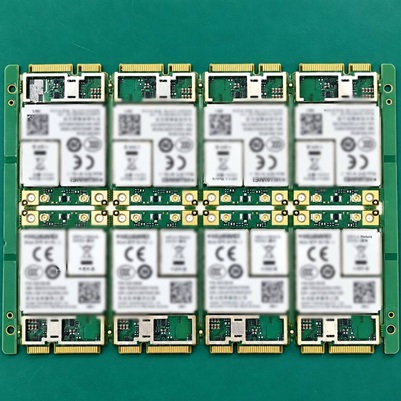
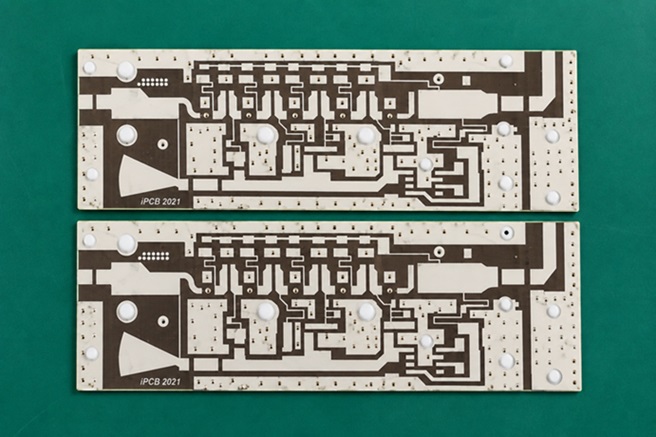
A ceramic PCB for RF and microwave applications can offer stable dielectric characteristics and low-loss performance compared with many conventional organic materials. This stability helps engineers control impedance and maintain predictable electrical behavior at high frequencies.
At higher frequencies, small variations in dielectric properties, conductor geometry, surface roughness, or dimensional stability can become significant signal-integrity problems.
In other words, high-frequency design is not only about the circuit itself. The substrate is part of the circuit's electrical behavior.
07. Integration Eliminates Failure Points
One of ceramic technology’s most underrated strengths is integration capability. A single ceramic platform can combine circuit metallization, vias and interconnects, embedded resistors, and packaging structures—while remaining fully compatible with wire bonding, chip‑and‑reel, and standard SMT assembly. Fewer parts, fewer interfaces, fewer potential failure points. This lowers assembly complexity, reduces interconnect‑related failures, and simplifies supply chains.
08. It Is Not an Upgrade — It Is a Different Approach
Moving from FR-4 to ceramic should not always be viewed as simply upgrading to a more expensive PCB material.
The engineering philosophy is different.
Instead of treating thermal management, mechanical stability, electrical performance, and reliability as separate problems, ceramic technology allows them to be considered together at the substrate level.
This becomes especially valuable when an electronic system needs to combine high power, high frequency, compact dimensions, and long operating life.
That is why ceramic technology continues to find applications in power modules, EV electronics, aerospace and defense, RF and microwave systems, LED and laser devices, medical electronics, and other demanding fields.
The key question is not whether ceramic is “better” than FR-4. The real question is whether the application's physical requirements have already moved beyond what conventional organic PCB materials can efficiently provide.
When you demand high thermal conductivity, precise CTE matching, and consistent high-frequency performance under extreme conditions, ceramic technology offers more than heat dissipation. For engineers searching for ceramic cutting boards, ceramic PCB, or high-reliability ceramic circuit boards, its real value lies in providing a fundamentally different approach to designing the electronic foundation itself.