A Trustworthy PCB and Electronic Manufacturing Enterprise! Contact Us


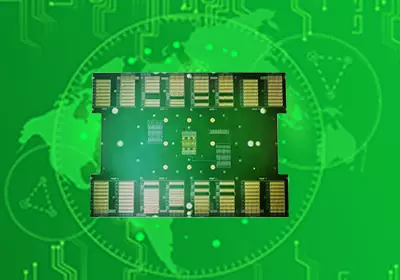
Modern imaging technology demands sophisticated electronic platforms capable of delivering exceptional image quality while maintaining compact designs and energy-efficient power consumption. Camera pcb board solutions integrate advanced image sensors, high-speed signal processing, and precision optical controls, making them suitable for diverse applications ranging from consumer electronics and security systems to industrial automation.
The camera PCB serves as the brain and nervous system of a camera, determining its image acquisition capabilities, signal transmission speeds, and overall performance. Depending on the specific application scenario, camera PCBs can be broadly categorized into consumer-grade PCBs (e.g., for mobile phones and laptops), industrial-grade PCBs (e.g., for machine vision and inspection systems), and professional-grade PCBs (e.g., for medical endoscopes and aerial drones). These different types of PCBs vary significantly in terms of size, layer count, component density, and signal processing capabilities.
Camera PCB Boards Structure
The structure of a camera circuit board typically comprises the following key components:
Substrate
The substrate serves as the foundational material of the PCB, primarily functioning to support electronic components and provide a medium for conductive circuitry. Common substrate materials include FR-4, ceramics, and flexible polyimide. For miniature cameras and high-performance industrial cameras, Flexible PCBs (FPCBs) are becoming increasingly prevalent, as they effectively meet the design requirements for miniaturization, lightweight construction, and high component density.
Image Sensor Interface
The image sensor is the core component of a camera, responsible for capturing light signals and converting them into electrical signals. The interfaces and circuitry on the PCB are tasked with supplying power to the sensor, providing clock signals, and transmitting the captured image data. High-end camera PCBs typically employ multi-layer routing to ensure high-speed data transmission and signal integrity.
Signal Processing Module
Camera PCBs typically integrate an Image Signal Processor (ISP) chip, which is responsible for processing raw image data through operations such as noise reduction, image enhancement, white balance adjustment, and color correction. The design of this module directly impacts the resulting image quality and frame rate.
Power Management
The camera circuit board utilizes voltage regulators, power filters, and protection circuits to deliver stable voltage to each of its various modules. A well-designed power management system not only ensures the stable operation of the system but also helps reduce power consumption and extend the device's overall lifespan.
Interfaces and Control
Camera PCBs typically feature various interfaces—such as I2C, SPI, USB, and MIPI—to facilitate communication with the main control board or host processor. Furthermore, functional modules such as LED flash drivers, autofocus controllers, and Optical Image Stabilization (OIS) drivers may also be integrated.
Packaging and Protective Layers
The surface of the PCB is typically covered with a protective coating (Solder Mask) and a solder resist layer to prevent short circuits, corrosion, and electrostatic damage, while simultaneously enhancing mechanical strength. Flexible PCBs may also incorporate protective films and laminating materials to improve bending resistance and overall durability.
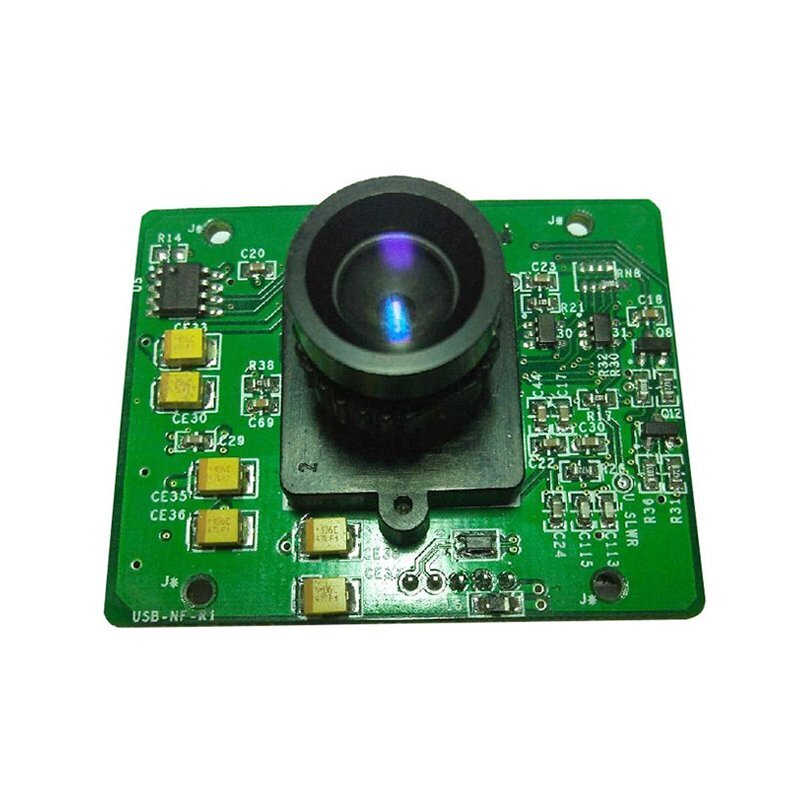
Camera PCB Boards
Camera PCB Board Manufacturing Process
Substrate Selection: The mainstream choice is FR-4 high-Tg (glass transition temperature) flame-retardant substrate (Tg ≥ 170°C). For outdoor or industrial-grade products, modified substrates capable of withstanding extreme temperatures are selected; these allow for stable operation in environments ranging from -40°C to 85°C and offer resistance to UV radiation and moisture-induced corrosion.
Layer Count and Layout: Standard designs typically utilize 4 to 8 PCB layers, featuring high-density routing to accommodate the compact arrangement of the image sensor, main control chip, and transmission modules. Core signal lines (such as image transmission and power supply lines) are laid out separately to minimize crosstalk.
Drilling Process: Carbide drill bits are employed (operating at speeds of 80,000 to 100,000 RPM). Standard hole diameters are ≥ 0.2 mm; for high-density areas, laser drilling (hole diameters ≤ 0.1 mm) is utilized to prevent scorching of the substrate resin and fraying of the glass fibers.
Lamination Parameters: The process adheres to the substrate manufacturer's recommended curing profile—typically involving temperatures of 180–200°C, pressures of 250–300 psi, and a holding time of 60–90 minutes—to ensure complete resin curing. Optical alignment technology is utilized to maintain an interlayer alignment tolerance of ≤ ±0.015 mm, thereby guaranteeing impedance consistency.
Surface Finish: For pad areas, the Electroless Nickel Immersion Gold (ENIG) process is prioritized (with a gold plating thickness of ≥ 30 µ-inches) to enhance soldering reliability and wear resistance. For applications in salt-spray environments, the Electroless Nickel Electroless Palladium Immersion Gold (ENEPIG) process is adopted to provide superior corrosion resistance.
What are the applications of Camera PCB Boards?
Camera circuit boards represent a type of miniature-footprint camera module, highly prized for their inherent versatility.
Essentially, they function as digital cameras in which the optical recording components—specifically the image sensor, lens, and aperture—are mounted directly onto the PCB substrate. Camera PCB assemblies feature a standard array of input and output capabilities.
In this regard, camera PCBs are invariably compact in size, typically accommodating lens diameters as small as 1/3 of an inch. These camera PCBs enable designers to streamline componentry, thereby facilitating space-saving camera designs.
Driven by advancements in technology and internet infrastructure, network speeds have improved dramatically.
This progress serves as a complementary force to the ongoing evolution of modern photographic imaging devices.
Common applications for camera PCB boards can be found in surveillance systems, medical equipment, various electronic devices, drones, robotics, personal computers, tablets, and smartphones.
As the core component of any camera system, the design, manufacturing, and functionality of a camera PCB board directly determine the overall performance of the camera itself. With the widespread adoption of smart devices, the upgrading of industrial automation, and the rapid development of artificial intelligence, camera PCB technology continues to undergo constant innovation—spanning miniaturization, high-speed processing, intelligent capabilities, and high levels of integration—all of which are propelling the entire industry to new heights. Ultimately, camera PCB boards bring greater convenience and expanded possibilities to both human daily life and industrial production.