A Trustworthy PCB and Electronic Manufacturing Enterprise! Contact Us


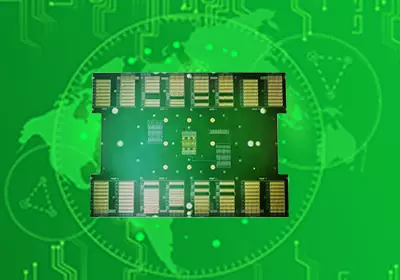
Ceramic PCBs use specialized ceramics as insulating substrates, offering advantages such as high thermal conductivity, high insulation, low thermal expansion, high temperature resistance, and aging resistance. They serve as the core carrier for high-end power circuits and RF packaging. Combined with physical product diagrams, this article systematically explains Ceramic PCB substrates, mainstream processes, core advantages, applications, and selection logic.
Ceramic PCB substrates are classified into alumina, aluminum nitride, and silicon nitride. They differ significantly in appearance, performance, and cost, serving as the primary criteria for design and selection.
1.Alumina Ceramic (Al2O3)
This substrate has the largest industry volume and best cost-performance ratio. It features a mainstream purity of 96%/99%, thermal conductivity of 20–35 W/(m·K), excellent insulation, corrosion resistance, and mature processing. The finished products usually have a matte white ceramic base with clean copper traces, widely used in high-power LEDs and standard power modules. The main drawback is its limited heat dissipation, making it unsuitable for ultra-high-power devices.
2.Aluminum Nitride Ceramic (AlN)
A high-end, highly thermally conductive substrate, it offers a thermal conductivity of 170–230 W/(m·K). Its coefficient of thermal expansion (CTE) matches silicon/silicon carbide chips, and it exhibits extremely low high-frequency loss. The finished base appears light gray and is mostly used for millimeter-wave RF, lasers, and high-end IGBT substrates. It comes with a higher cost.
3.Silicon Nitride Ceramic (Si3N4)
The ultimate substrate for reliability, featuring a thermal conductivity of 80–120 W/(m·K). Its mechanical toughness and thermal shock resistance far exceed the previous two, making it highly resistant to cracking during high-low temperature cycling. The finished products are mostly used in automotive power modules and military equipment. It carries the highest material and processing costs.
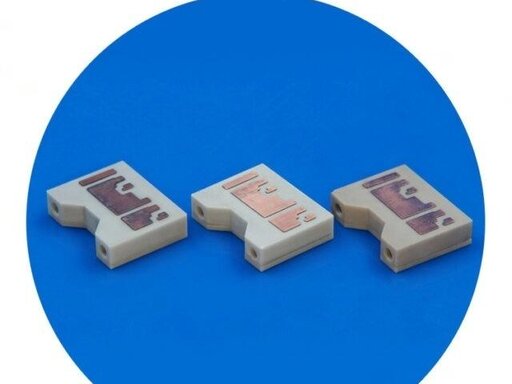
AL2O3, AIN, Si3N4 PCB
Since ceramic is hard and brittle, traditional PCB lamination processes cannot be used. The industry relies on four dedicated metallization processes, each corresponding to different trace precision and current-carrying capabilities.
1. DBC (Direct Bonded Copper) Process
Copper foil is directly bonded to the ceramic at high temperatures, eliminating risks of delamination from adhesives. It supports a copper thickness of 105–600 μm, providing strong current-carrying capacity. The finished trace width/spacing is ≥100um, meaning the wiring is relatively coarse. It is suitable for new energy electronic controls and high-power IGBT modules.
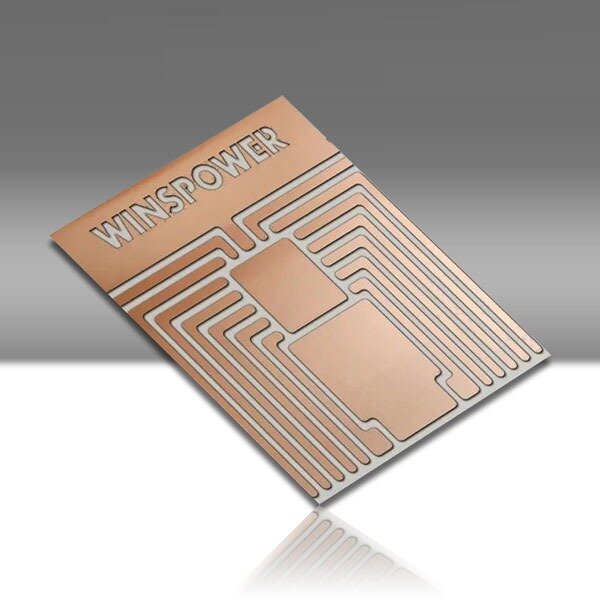
DBC PCB
2. DPC (Direct Plated Copper) Process
Utilizes PVD to deposit a seed layer followed by electroplating, yielding extremely high trace precision. It achieves a minimum trace width/spacing of 20 μm and a flat, smooth surface. The finished traces are fine and dense, making it ideal for RF, miniature sensors, and laser devices.
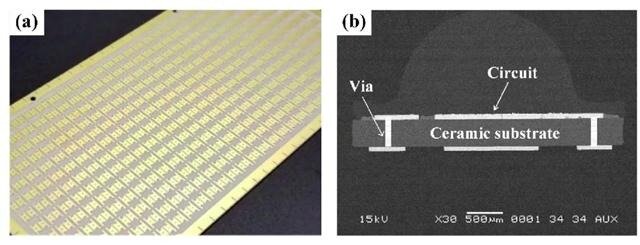
DPC
3. AMB (Active Metal Brazing) Process
Vacuum brazing achieves high-strength bonding between copper and ceramic. Its resistance to thermal shock and temperature cycling far exceeds that of DBC. Silicon nitride AMB finished products are standard for automotive SiC power modules, remaining free from delamination or cracking under long-term high-temperature conditions.
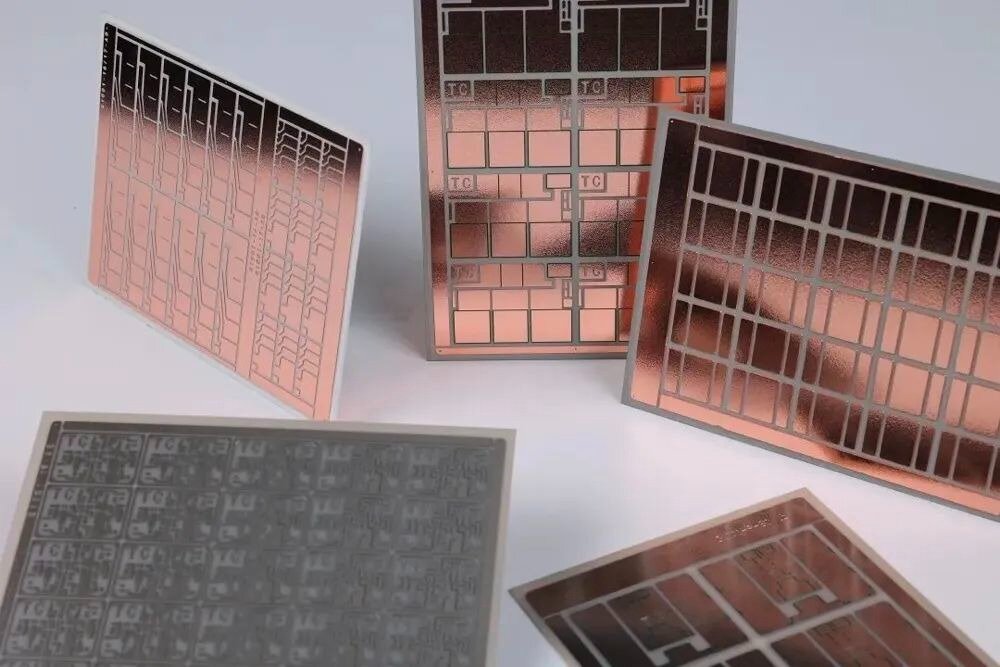
AMB PCB
4. LTCC/HTCC (Low/High Temperature Co-fired Ceramic) Process
Multilayer ceramics are sintered synchronously, allowing resistors and capacitors to be embedded internally for high integration. LTCC finished products are mostly used for 5G RF modules, while HTCC offers high-temperature resistance suitable for aerospace multilayer circuits.
Core Advantages of Ceramic PCBs over Traditional PCBs
1.FR-4 has a thermal conductivity of only 0.3–0.4 W/(m·K), whereas aluminum-based substrates top out at 150 W/(m·K); ceramics cover the range from low/medium to ultra-high power dissipation, rapidly conducting heat away to prevent component burnout due to high temperatures.
2.Stable thermal matching; resistant to failure.
The coefficient of thermal expansion of the ceramic is close to that of the power chip; consequently, long-term thermal cycling does not cause substrate deformation or pad detachment, significantly extending the equipment's service life.
3.High-frequency, low-loss
Free from organic resin polarization loss and exhibiting minimal signal attenuation in millimeter-wave and microwave applications, it is the optimal substrate for RF communication.
4.High insulation and resistance to harsh environments
Features excellent withstand voltage and insulation properties; operates stably between -55°C and 850°C; and resists acids, alkalis, moisture, and dust.
5.High-current carrying capacity
DBC/AMB thick-copper finished products can handle very high currents and feature uniform impedance, making them suitable for power circuits.
Mainstream industry application scenarios:
1.New Energy Vehicles: Silicon nitride AMB ceramic substrates are widely used for electronic control systems, on-board fast-charging units, and IGBT modules.
2.5G/6G RF communication: Radar and RF modules utilizing high-precision DPC and LTCC ceramic PCBs;
3.Optoelectronic lighting: High-power LEDs, UV lamp boards, and 96% alumina DBC boards are the mainstream products.
4.Defense and Aerospace: Radar and telemetry/tracking equipment; aluminum nitride and HTCC multilayer ceramic substrates;
5.Medical / High-end Industrial Control: Laser instruments and high-voltage testing equipment, leveraging the high insulation and low interference characteristics of ceramics.