A Trustworthy PCB and Electronic Manufacturing Enterprise! Contact Us


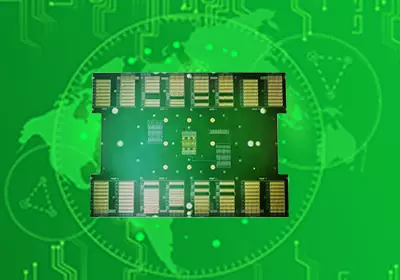
A USB Hub PCB is a high-efficiency circuit board that powers USB ports. Typically integrated into desktop computers, it allows users to connect multiple devices as needed. Essentially, it manages the upstream and downstream ports of the USB hub.
Connecting various electronic devices to a multi-port USB hub ensures optimal data transmission and significantly enhances the efficiency of connected devices. Its versatility allows it to be used in applications ranging from switches to kitchen appliances.
In terms of durability, this specific board offers a long service life. Furthermore, efficient thermal management and impedance control make this PCB an excellent choice for high-frequency electronic applications.
Structural Composition of a USB Hub PCB
A standard USB Hub PCB typically comprises the following sections:
1. Main Controller Chip Area
This is the core of the PCB; the layout should be as close as possible to the upstream interface to minimize signal loss. High-speed USB standards (such as USB 3.0, 3.1, and 3.2) impose strict requirements on trace length and impedance matching.
2. Differential Signal Traces
USB data lines utilize differential signaling (D+/D- or TX/RX pairs), requiring strict control over:
Impedance matching (typically 90Ω differential impedance)
Trace length matching
Minimizing the number of vias
3. Power Management Circuitry
Includes:
LDO or DC-DC converters
Over-current protection (OCP)
Electrostatic discharge (ESD) protection
Power filtering capacitors
4. USB Interface Area
USB Type-A or Type-C interfaces are the most common forms; mechanical strength and solder pad reliability must be considered.
5. Grounding and Shielding Design
A robust grounding design effectively reduces EMI (electromagnetic interference) and improves signal integrity.
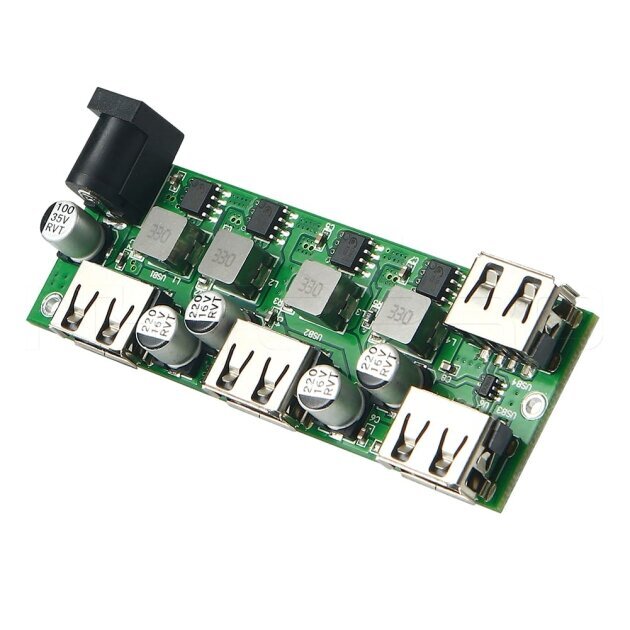
USB Hub PCB
How Does a USB Hub PCB Work?
The superior characteristics of the USB Hub PCB enable the connection of numerous devices to a server via USB (Universal Serial Bus).
Additionally, USB hubs typically feature sufficient upstream and downstream ports. The upstream port collects data from the host system, which is then transmitted to the devices connected to the downstream ports. It incorporates functional components—such as transmitters, antennas, diodes, and other elements—that regulate data transmission from the host to the target port.
Thanks to the USB 3.0 hub PCB, USB ports can transmit data directly to the destination. Reducing signal strength at the USB interface helps minimize unnecessary energy consumption.
Key Features of the USB 3.0 Hub PCB
Significant advancements have been made in USB 3.0 hub PCB technology within the electronics sector. It offers remarkable features that greatly enhance device functionality. Its most notable characteristics include:
Compatibility with Micro-A, Micro-B, and Micro-C connectors.
A bandwidth of 5 Gbps.
Capability to operate under extreme temperatures (utilizing high-Tg PCB material).
Accelerated charging capabilities and reliable power management.
Facilitation of signal transmission between the port and the host computer.
High resistance to moisture and chemical contaminants.
High dielectric strength and low relative permittivity.
Utilization of point-to-point packet routing.
As a vital component of modern electronic systems, the design and manufacturing quality of the USB hub PCB directly impact the overall device's performance and stability. Every aspect—from signal integrity and power design to the PCB fabrication process—is crucial. As USB technology continues to evolve, USB hub PCBs are advancing toward higher speeds, greater component density, and increased intelligence.