A Trustworthy PCB and Electronic Manufacturing Enterprise! Contact Us


In PCB manufacturing, wire-to-board (Wire-to-PCB) connections are widely used in power electronics, LED drivers, industrial control systems, sensors, and various RF and automotive applications.
From a functional perspective, these connections usually work well during prototyping. However, during DFM (Design for Manufacturability) review and mass production, we frequently observe that some designs which appear “acceptable on paper” can lead to long-term reliability issues in real applications.
Most of these issues are not caused by soldering defects on the production line, but are instead related to design decisions made at the PCB layout stage.
Below are five common issues we frequently identify during DFM review.
1. Pad design that is electrically sufficient but mechanically weak
In many designs, the PCB pad is sized only to ensure electrical connectivity of the wire. However, mechanical loading is often not considered.
In real-world use cases, the wire may be subject to:
vibration
cable movement
transportation stress
accidental pulling
When the pad area is too small, the mechanical load is concentrated at the copper–solder interface. Over time, this can lead to:
micro-cracks at the pad edge
fatigue failure under vibration
eventual pad lifting from the FR4 substrate
From a manufacturing perspective, the key issue is not whether the wire can be soldered, but whether the stress is properly distributed into the PCB structure rather than concentrated at a single copper pad.
2. Improper PTH hole sizing affects solder filling behavior
Plated Through Hole (PTH) connections are often used for higher reliability wire-to-board interfaces.
However, we frequently see two opposite issues in design:
Hole size too small:
wire insertion becomes difficult
flux cannot fully penetrate the hole
solder flow is restricted
internal voids may form
Hole size too large:
wire is not mechanically constrained
capillary action is weakened
insufficient solder fillet formation
reduced mechanical strength
The key point is not whether the wire fits, but whether the solder can form a stable capillary-filled joint inside the hole.
In DFM evaluation, we usually assess hole size based on wire diameter, board thickness, and plating conditions rather than using a fixed rule.
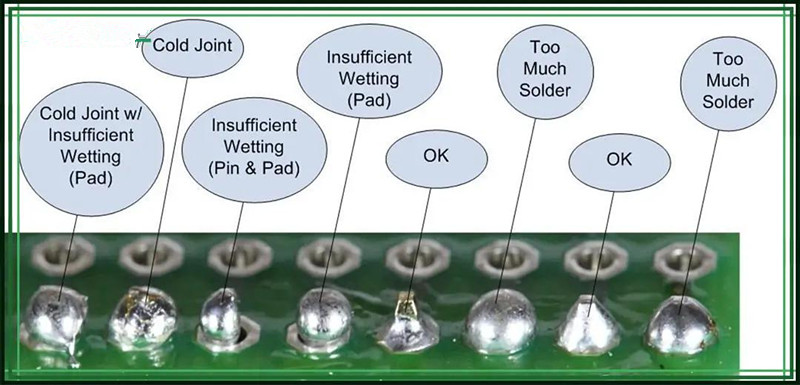
3. Lack of strain relief is one of the most common failure causes
One of the most frequent reliability issues we observe is that the solder joint is unintentionally used as a mechanical support structure.
For example:
power wires directly pulling on the pad
sensor wires exposed to continuous vibration
repeated bending during handling or transport
In these cases, even if solder quality is perfect, the joint will eventually fail because mechanical stress is continuously applied to the solder interface.
From a DFM perspective, a fundamental principle should be followed:
The solder joint should provide electrical connection only, not mechanical fixation.
To improve reliability, common solutions include:
adding cable tie or fixing holes
using adhesive or potting for strain relief
adjusting wire routing direction
avoiding direct 90-degree pull on solder joints
4. Copper thickness increases thermal mass and affects soldering quality
In power and high-current designs, copper thickness is often increased to 2 oz or more. While this improves current handling, it also significantly affects soldering behavior.
During DFM review, we often observe that:
thicker copper increases thermal mass
solder joints take longer to reach proper wetting temperature
operators may remove the soldering iron too early
insufficient intermetallic compound (IMC) formation occurs
As a result, the joint may appear visually acceptable, but the internal metallurgical bond is not fully developed.
From a manufacturing point of view, copper thickness changes not only electrical performance but also the thermal response behavior of the entire soldering process.
5. Surface finish has a direct impact on solder reliability
Surface finish is often underestimated in wire-to-PCB connections, but it plays a critical role in wetting behavior and long-term reliability.
ENIG (Electroless Nickel Immersion Gold)
stable solderability
suitable for high-reliability applications
good storage performance
may show interface degradation after excessive rework cycles
HASL (Hot Air Solder Leveling)
excellent solder wetting performance
lower cost
surface non-planarity may affect precision designs
OSP (Organic Solderability Preservative)
cost-effective
limited storage and processing window
more sensitive to handling and oxidation
In DFM review, we do not select surface finish purely based on solderability, but based on:
product lifetime requirements
assembly process conditions
expected rework frequency
environmental exposure
Conclusion: Wire-to-PCB reliability is a design issue, not just a soldering issue
From a manufacturing perspective, wire-to-PCB failures are rarely caused by soldering workmanship alone.
Instead, they are usually the result of a combination of:
mechanical stress distribution
PCB pad and hole design
thermal behavior during assembly
material and surface finish selection
A well-designed Wire-to-PCB interface should ensure that:
the solder joint remains electrically stable while being mechanically protected throughout the product lifecycle.
In many cases, these reliability risks can be significantly reduced during the early DFM stage before production begins.