A Trustworthy PCB and Electronic Manufacturing Enterprise! Contact Us


Most PCB insulation degradation, solder corrosion, and hidden electrical failures in PCBA production and rework are caused by residual contaminants rather than design defects. Typical pollutants include flux residue, ionic contamination, micro oil, and dust scaling. Circuit board cleaner performance directly affects PCB insulation stability, solder reliability, and long-term device durability.
This article compactly explains the core technical logic of PCB cleaners, covering cleaning mechanisms, key parameters, product classification, process matching, industry standards, and field selection principles to support R&D and manufacturing process optimization.
1.PCB Contamination Types & Technical Pain Points
PCB cleaning aims to strip contaminants and eliminate polar ionic residues. Industrial pollutants fall into four categories:
- Non-polar organic contamination: Rosin resin, flux carriers, and grease. They form insulating layers and lead to poor soldering and intermittent contact.
- Polar ionic contamination: Halides, organic acids, plating residues, and salt ions. These cause leakage, electrochemical migration, dendrite growth, and solder corrosion, which dominate long-term PCB failure risks.
- Solid particle contamination: Solder balls, slag, fiber dust, and debris trapped under BGA, QFN, and pin gaps, which cannot be removed by simple wiping.
- Composite scaling: Oil-ion-dust mixed deposits that absorb moisture and continuously degrade PCB insulation, common in automotive and outdoor industrial devices.
- Core pain point: IPA and low-cost cleaners only provide surface cleaning. They lack micro-gap penetration, ionic removal, stable substrate compatibility, and zero-residue performance — the key gap between consumer-grade and industrial-grade cleaners.
2. PCB Cleaning Mechanism: Chemical & Physical Synergy
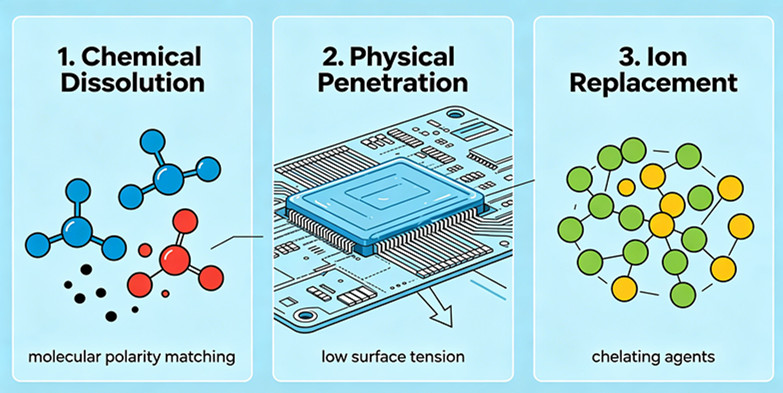
Industrial PCB cleaning relies on three synergistic effects: chemical dissolution, physical stripping, and ionic replacement. Two parameters determine final cleaning quality.
2.1 Dissolving Power (KB Value)
The KB value (Kauri-Butanol value) defines solvent capability to dissolve rosin and cured flux. IPA features low KB value and cannot remove high-temperature cured reflow residues. Industrial composite solvents adopt matched molecular polarity to strip cured organics efficiently.
2.2 Surface Tension & Penetration
For high-density packages (0402, BGA, QFN), cleaners require dynamic surface tension ≤ 20 mN/m to penetrate micro gaps and component bottoms, eliminating hidden residual contamination.
2.3 Ion Removal Capability
Water-based and semi-water-based formulas contain chelating agents and surfactants to dissociate and wash away halide and metal ions, reducing board-level ionic contamination. This capability is essential for high-reliability automotive, medical, and industrial electronics.
3. Three Mainstream Cleaner Types & Technical Comparison
Industrial PCB cleaners are categorized into solvent-based, water-based, and semi-water-based types, each with distinct process suitability.
3.1 Solvent-Based Cleaners
Formula: Hydrocarbon/modified alcohol/fluorinated solvents (water-free).
Advantages: Fast volatile, zero water residue, no drying required; good compatibility with PCB substrates, inks, and plastics; high insulation resistivity (≥1×10⁹ Ω·cm, IPC-TM-650 compliant) allowing immediate power-on test.
Limitations: Poor ionic removal; limited performance on heavily cured flux; low-grade formulas carry flammability and VOC risks.
Best for: Sparse rework, lab maintenance, and no-drying conditions (use flash point >60℃ formulas).
3.2 Water-Based Cleaners
Formula: Deionized water + surfactants + chelators + corrosion inhibitors (zero VOC solvents).
Advantages: 95%+ ionic contamination removal; stable defoaming and wettability for ultrasonic/spray lines; non-flammable, low toxicity; protects copper, gold, and tin plating.
Limitations: Requires 80–120℃ drying to avoid micro-shorts from residual water; slower for heavy cured flux; low-quality solutions may whiten plastic parts.
Best for: High-reliability mass production (automotive, medical, military, industrial).
3.3 Semi-Water-Based Cleaners
Formula: Organic solvent + pure water + composite surfactants.
Advantages: Balances organic dissolution and ionic cleaning; higher efficiency than water-based formulas and lower cost than pure solvents.
Limitations: Needs rinsing and drying; improper ratio may cause watermarks.
Best for: High-density PCBA mass production and heavy-residue board batch cleaning.
4. Cleaner & Process Matching Rules
Most cleaning defects come from process-solution mismatch rather than poor cleaner quality:
- Ultrasonic/Megasonic: Water/semi-water-based cleaners with ≤20 mN/m surface tension for efficient micro-bubble cavitation and gap cleaning.
- High-pressure spray: Low-viscosity water/semi-water formulas to avoid nozzle clogging and uneven cleaning.
- Manual/aerosol rework: Fast-drying solvent-based cleaners for zero-residue local repair.
- Vapor phase cleaning: Low-boiling high-purity solvents for full infiltration and no drying needed.
5. Industry Standards & Acceptance Criteria
Qualified industrial cleaning requires standardized verification, not visual inspection:
- IPC-J-STD-001: Defines post-solder cleaning requirements for non-corrosive, non-residue performance.
- IPC-A-610: Regulates surface cleanliness and electrical acceptance.
- IPC-TM-650 2.6.3.7: Resistivity test standard to prevent leakage.
- ISO 16232: Automotive-grade ionic residue control.
- Medical standards: Mandate non-toxic, bio-safe water-based formulas.
Key mass-production indicator: Ionic contamination ≤ 1.56 μg(NaCl)/cm², stable insulation, no plating corrosion, no visible residue.
6. Quick Selection Guidelines
Select PCB cleaners based on contamination type, process conditions, and reliability grade:
1. Sparse rework & no drying: High-flash fast-drying solvent cleaners.
2. High-reliability mass production: Neutral water-based cleaners with ultrasonic/spray + drying process.
3. Heavy mixed contamination batch production: Semi-water-based cleaners for balanced efficiency and cost.
4. General principle: Prioritize surface tension, resistivity, substrate compatibility and comply with industry standards.
PCB cleaning is a critical hidden process in electronics manufacturing. Correct cleaner selection and process matching effectively reduce corrosion and leakage risks, improving product stability and service life at low cost.