A Trustworthy PCB and Electronic Manufacturing Enterprise! Contact Us


Understanding the basics of fiberglass PCBs: PCB technology has played a pivotal role in shaping the modern electronics industry—from smartphones and computers to satellites and electric vehicles. Among the many types of PCBs available, the fiberglass PCB stands out as a widely adopted and versatile solution, serving as the backbone for countless electronic components. Although its significance is often underestimated, its structural and thermal properties make it a foundational material for both consumer-grade and industrial-grade electronics.
A fiberglass PCB is, in essence, a circuit board whose substrate is composed of fiberglass-reinforced epoxy resin (typically FR-4). This material provides a robust, thermally stable, and mechanically strong base for mounting copper traces and other components. This configuration enables the integration of signal routing, mechanical support, and various functionalities within a compact space.
While other substrate materials exist—such as ceramics, polyimides, and metal cores—the fiberglass variant strikes an optimal balance between performance, cost-effectiveness, and ease of manufacturing. It is precisely this balance that makes fiberglass PCBs the default choice for the majority of electronic designs today.
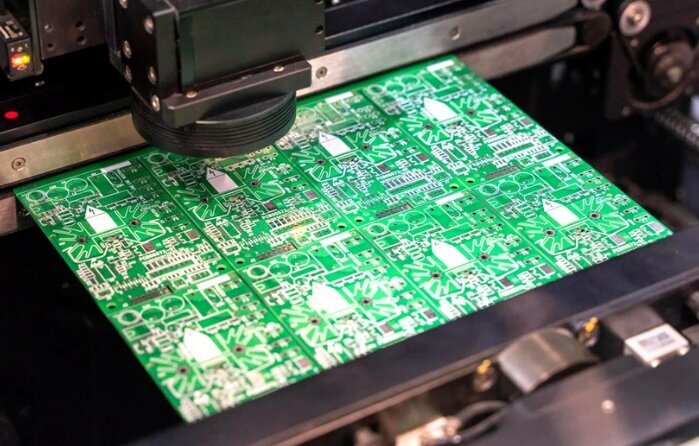
fiberglass pcb
How Are Fiberglass PCBs Manufactured?
The production process for fiberglass PCBs is precise and rigorous, primarily involving the following steps:
Lamination: Pressing copper foil together with the FR-4 fiberglass substrate.
Drilling: Using CNC drilling machines to create through-holes or mounting holes.
Plating and Etching: Electroplating copper inside the holes and etching the copper foil to form the circuit patterns.
Solder Mask Application: Spraying solder mask ink to prevent short circuits.
Silkscreen Printing: Printing text, reference designators, or customer logos.
Surface Finish: Applying finishes (such as ENIG or HASL) to enhance solderability and oxidation resistance.
Electrical and Visual Inspection: Testing to ensure there are no open circuits, short circuits, dimensional errors, or visual defects. This process applies to the manufacturing of PCBs ranging from single-layer to multi-layer designs and is critical for ensuring product consistency and reliability.
The Role of Fiberglass in PCB Substrates
The core characteristic of a fiberglass PCB lies in its substrate material. The substrate serves as the insulating base layer that gives the PCB its physical form and provides structural support for the copper circuitry laid out upon it. Fiberglass typically takes the form of a woven fabric; once impregnated with epoxy resin and cured, it forms a robust, heat-resistant circuit board.
The most common standard material for fiberglass PCBs is FR4—a fiberglass-reinforced epoxy laminate. "FR" stands for "Flame Retardant," and FR4 is highly regarded for its stable mechanical and electrical properties. The fiberglass cloth used in FR4 is typically E-glass, characterized by its high dimensional stability and high tensile strength.
From a materials science perspective, fiberglass plays three key roles in PCB construction:
Mechanical Strength: Fiberglass provides rigidity and mechanical durability. It prevents warping and delamination, even in environments subject to high temperatures or intense vibration.
Thermal Stability: Fiberglass possesses a relatively high glass transition temperature (Tg), enabling the PCB to withstand the heat generated during soldering processes and normal operation without deforming.
Dielectric Properties: The epoxy-fiberglass matrix provides electrical insulation, ensuring that electrical signals traveling through adjacent traces do not interfere with one another.
These characteristics have made fiberglass PCBs the de facto standard in the industry for decades.
Common Applications for Fiberglass PCBs
Thanks to their exceptional overall performance, fiberglass circuit boards are widely utilized in the following sectors:
Consumer Electronics: Smartphones, laptops, smart wearables, gaming consoles.
Automotive Electronics: Instrument clusters, central control units, LED vehicle lighting, etc.
Industrial Equipment: PLC controllers, sensors, power supply modules, etc.
Medical Devices: Non-critical instruments such as digital thermometers and home diagnostic devices.
LED Lighting Products: LED strips, light bulbs, display modules.
This encompasses virtually every category of electronic product, ranging from everyday consumer goods to industrial automation systems.
iPCB is China's most reliable and professional supplier of fiberglass PCBs!
We are an experienced company with over 15 years of expertise in the manufacturing and export of fiberglass PCBs board. Our robust R&D team is dedicated to providing professional technical support for PCB-related inquiries to clients worldwide.