A Trustworthy PCB and Electronic Manufacturing Enterprise! Contact Us


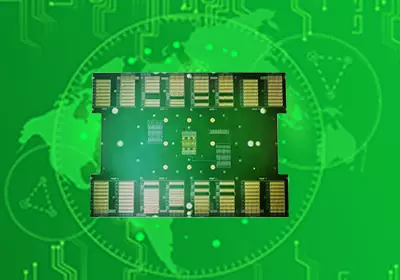
A circuit control board is typically a printed circuit board (PCB) assembly that integrates core chips such as microcontrollers (MCUs), digital signal processors (DSPs), or complex programmable logic devices (CPLDs). It connects various electronic components through circuit design to form a complete control system. Simply put, the function of a control board is to receive input signals (from sensors, buttons, etc.), perform internal logic operations and processing, and then output control signals to drive external devices (such as motors, relays, displays, etc.) to execute specific actions.
A typical control board usually comprises the following core sections:
Control Module: Centered around a microcontroller or microprocessor, this acts as the "brain" of the control board, responsible for executing program instructions and processing data.
Power Supply Module: Converts external input voltage into the stable, low-voltage power required by the board's internal components, ensuring stable circuit operation.
Input/Output (I/O) Module: Connects input devices (such as sensors and switches) and output actuators (such as relays and indicator lights).
Communication Module: Enables data exchange between the control board and external devices or other control boards; common interfaces include RS-422, I2C, and SPI.
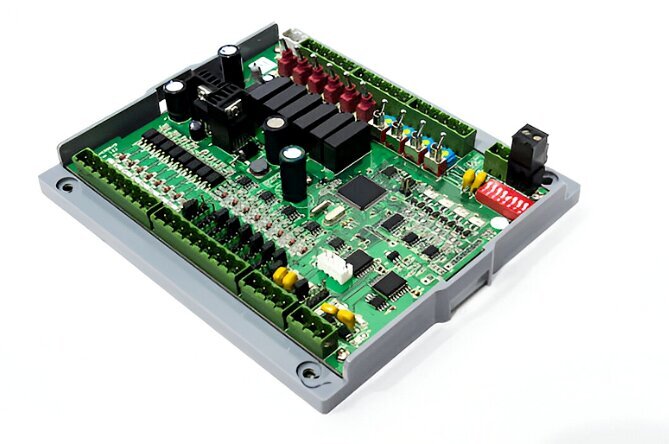
circuit control board
Types of Circuit Control Board
Industrial Control Boards
In industrial equipment, these are often referred to as power control boards, which can be further categorized into medium-frequency and high-frequency power control boards. Medium-frequency power control boards are typically connected to thyristor-based medium-frequency power supplies and used in conjunction with other medium-frequency industrial equipment, such as medium-frequency electric furnaces, quenching machine tools, and forging equipment. High-frequency control boards used in high-frequency power supplies can be categorized into IGBT and KGPS types; due to their energy-saving characteristics, IGBT-based high-frequency boards are widely used in high-frequency equipment. Motor Control Boards
Motors serve as the actuators and most critical components of automation equipment; metaphorically, they act like human hands performing direct operations. Effectively directing these "hands" requires various motor drive and control boards. Common types include: AC induction motor (ACIM) control boards, brushed DC motor control boards, brushless DC (BLDC) motor control boards, permanent magnet synchronous motor (PMSM) control boards, stepper motor drive boards, asynchronous and synchronous motor control boards, servo motor control boards, and tubular motor drive boards.
Home Appliance Control Boards
These generally fall into categories such as: IoT controllers for appliances, smart home control systems, RFID wireless curtain control boards, floor-standing HVAC control boards, electric water heater control boards, range hood control boards, washing machine control boards, humidifier control boards, dishwasher control boards, commercial soy milk maker control boards, ceramic cooktop control boards, automatic door control boards, electronic lock control boards, and smart access control systems.
Medical Device Control Boards
Used in medical instruments to manage operation and data acquisition. Common products include: medical data acquisition control boards, electronic blood pressure monitors, body fat scales, heart rate monitors, massage chair controllers, and home physiotherapy device control boards. These require high reliability, low power consumption, and compliance with medical electrical safety standards.
Automotive Electronic Control Boards
Used in automotive electronic systems to monitor driving status in real-time and enhance safety and convenience. Common types include: in-vehicle refrigerator control boards, automotive LED tail light control boards, car audio control boards, GPS tracking control boards, tire pressure monitoring system (TPMS) boards, reversing radar control boards, electronic anti-theft system boards, ABS controllers, and HID headlight controllers. They must feature vibration resistance, high-temperature tolerance, and excellent electromagnetic compatibility (EMC).
Digital Power Control Boards
Used in high-power and high-end power management applications; compared to traditional transformer-based power supplies, they offer smaller footprints and higher efficiency. Key products include: digital power control modules, Li-ion battery charger control boards, solar charging control boards, smart battery monitoring boards, high-pressure sodium lamp ballast control boards, and high-pressure metal-halide lamp control boards. These products are widely used in the fields of new energy, energy storage, and high-efficiency lighting.
Communication Control Boards
These boards facilitate data communication between devices and fall into two main categories: wired and wireless. Common frequency bands for wireless communication boards include 315MHz/433MHz RFID, ZigBee, and 2.4GHz; wired communication boards primarily utilize RS485, GPRS remote monitoring, and similar technologies. As core components of IoT, smart home, and remote monitoring systems, stability and communication range are critical performance indicators.
Applications of Circuit Control Board
Control PCBs have a wide range of applications, including consumer electronics, industrial machinery, medical equipment, and automotive systems.
Automotive Industry
Circuit control boards are essential to automotive systems and serve a wide range of functions. They are used in sensors, navigation, powertrain control, safety control systems, engine management, lighting, and charging systems. Without these control PCBs, vehicles could not operate smoothly.
Consumer Electronics
Circuit control boards are ubiquitous in our daily lives. They are found in consumer electronic devices such as smartphones, game consoles, televisions, laptops, smartwatches, and smart headphones. The control PCBs within these devices ensure smooth and flawless operation.
Industrial Automation
Circuit control boards are also used in the industrial sector to manage the operation of industrial machinery. Engineers program these PCB controllers to manage the operation of equipment—such as motors and pumps—by processing user commands.
Medical Devices
In this field, circuit control boards are crucial for managing the operation of medical equipment, including X-ray machines, MRI scanners, infusion pumps, imaging systems, and other diagnostic devices. These often-unnoticed PCB controllers are vital to medical operations, enabling the collection and evaluation of patient data during diagnostic procedures.
Automotive Industry
Circuit control boards are essential to automotive systems and serve a wide range of functions. They are used in sensors, navigation, powertrain control, safety control systems, engine management, lighting, and charging systems. Without these control PCBs, vehicles could not operate smoothly. Generally speaking, PCBs serving as controllers are utilized in a wide range of applications. For instance, remote control PCBs are extensively used in appliance control, such as in smart home systems, allowing you to manage household devices even when you are away from home. Remote control PCBs also play a vital role in traffic light control systems. Without these PCB control panels, the aforementioned devices would cease to function. Furthermore, circuit control boards pave the way for advancements in cutting-edge medical technology.
Circuit control boards are essential for ensuring the smooth operation of electronic systems. They facilitate power control and data management while ensuring that the various components of the circuit board work together seamlessly.