A Trustworthy PCB and Electronic Manufacturing Enterprise! Contact Us


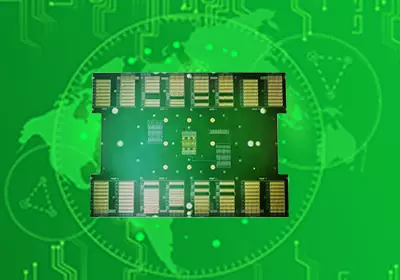
Not all circuit boards are square or rectangular. As technology becomes more compact and innovative, circular pcb boards are gaining popularity. These boards are designed for devices where traditional shapes do not fit well. You will find circular PCBs in products such as smartwatches, LED lights, and medical instruments. Their shape helps save space and results in a cleaner overall design.
Circular pcb board vs. Square/Rectangular PCBs
Most PCBs used in electronics are square or rectangular because they are easier to design, manufacture, and panelize for mass production.
However, these traditional shapes are not always the best solution—especially for modern devices with unique or curved forms.
The differences between circular and rectangular PCBs are as follows:
Space Efficiency: Circular pcb boards fit perfectly inside circular housings, eliminating wasted corner space.
Visual Design: For consumer-facing devices, a circular shape often looks sleeker and more modern.
Design Complexity: Creating a circular layout requires specialized routing tools and careful planning, making the process more time-consuming and costly than designing a rectangular board.
Customization: Circular pcb boards often involve custom form factors that cannot always be achieved with standard board shapes.
These boards are chosen for their ability to fit into tight spaces, enhance aesthetics, and support miniaturized, lightweight designs.
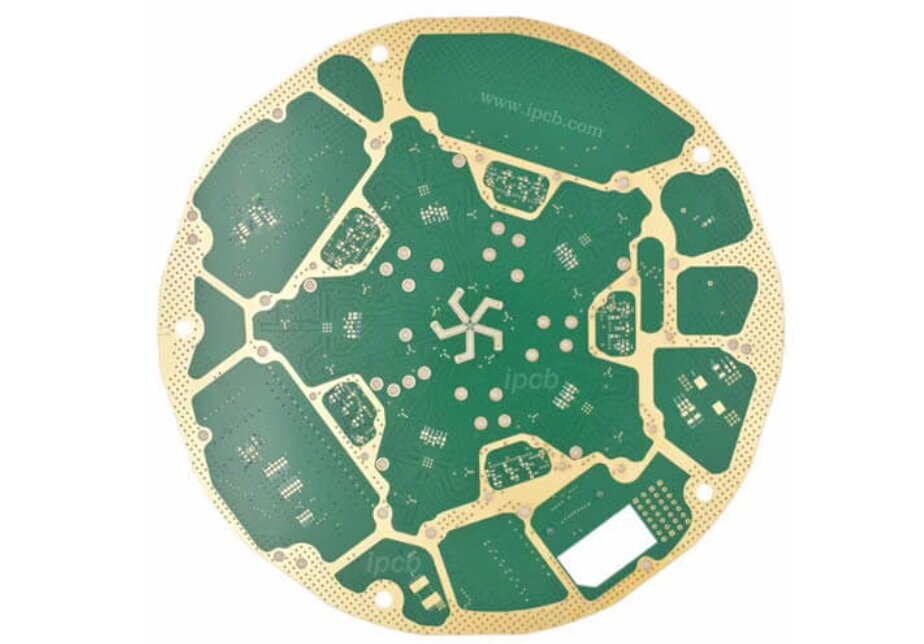
Circular pcb board
In what scenarios are Circular pcb boards used?
The defining characteristic of circular PCB applications is limited space and unique structural requirements. Consider the following product categories:
LED lighting is a prime example. For products like bulb lights, downlights, and ring lights, the housing is circular and the light source needs to be evenly distributed; thus, a circular aluminum-based PCB is the natural choice. Since LEDs generate significant heat, the thermal dissipation advantages of aluminum substrates apply equally to circular boards, and the circular structure facilitates even heat dispersion in all directions.
Smart wearables are another major application area. Smartwatches, fitness trackers, and health monitoring devices often feature circular housings for better aesthetics and a comfortable fit on the wrist; consequently, the internal circuit boards must also be circular. Circular PCBs maximize the use of limited internal space, allowing for the compact integration of batteries, sensors, and display driver circuitry.
Circular boards are also frequently used in sensor modules and industrial equipment. Products such as gas sensors, environmental monitoring equipment, and rotary encoders often require circular sealing structures, making a circular PCB a logical choice. Additionally, for products like wireless charging pads, microphone modules, and speaker control boards, circular PCBs better accommodate acoustic structures or coil layouts.
Designing Circular pcb boards is more complex. Fortunately, while few specialized tools exist specifically for this purpose, there are established design rules to follow. For instance, the board's perimeter must be formed using straight line segments. Furthermore, when laying out the perimeter lines, a circle should be placed on the silkscreen layer. Let’s examine some specific PCB layout and design rules:
Circular pcb board Design Rules
First, when using CAD software, it is important to draw the shape accurately within the tool.
Naturally, if the circular PCB is intended for high-speed devices, a multi-layer PCB is the default choice.
Power and ground planes must be defined on separate layers. A polygon editor can be used to define the shapes of these planes.
Some software packages also offer options for customizing power and ground planes.
It is also important to remember that circular PCB designs require a panelization strategy.
Routing (specifically, breakaway routing) is widely used for panelizing Circular pcb boards. A gap of 10 mm (approximately 0.39 inches) must be maintained between circular boards, though this gap may need to be increased depending on the size of the milling tool used.
Regarding mounting technology, both SMT (Surface Mount Technology) and THT (Through-Hole Technology) can be used for component placement, although SMT is generally more suitable.
To Be Round or Not to Be Round? That Is the Question
Ultimately, the emergence of circular PCBs stems from the fact that electronic product form factors are becoming less "boxy." Wearables need to fit the wrist, lighting products require uniform light distribution, and consumer electronics prioritize aesthetic appeal—all these factors drive the evolution of circuit boards from a "function-first" approach to one that balances both function and form.
At the end of the day, a PCB's shape isn't about aesthetics; it's about how well it serves the product. If your product has a round housing, a Circular pcb board is the natural choice; if it features a boxy chassis, a rectangular board remains the most cost-effective solution. When it comes to shape, suitability is what matters most. As for those still agonizing over whether circular pcb boards are difficult to make, try looking at it from a different perspective: the shape of a circuit pcb board is never the starting point of a design, but rather the answer to it. Once you have a clear vision for the product, the shape will naturally emerge.