A Trustworthy PCB and Electronic Manufacturing Enterprise! Contact Us


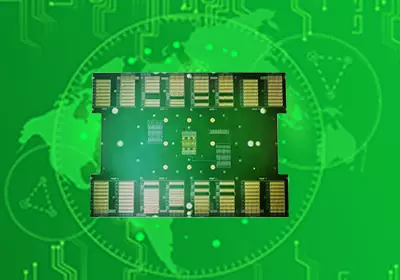
As multi-rotor, industrial, and commercial drones continue to advance, traditional printed circuit boards are no longer sufficient to meet modern flight requirements. The drone pcb board has become a core hardware component that directly affects flight stability, anti-interference performance, battery life, and operational safety. Under harsh conditions such as high-load operation, high-speed steering, strong electromagnetic interference, and rapid temperature rise, professional drone pcb board solutions must meet higher design and manufacturing standards than general consumer electronics.
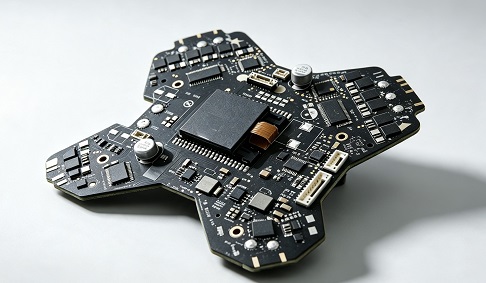
Today’s drone circuits are no longer simple carrier substrates. They require a careful balance of signal integrity, current carrying capacity, thermal management, and structural durability. Higher layer counts, high-density interconnect (HDI) structures, precise copper thickness control, excellent dimensional stability, and optimized heat dissipation have all become essential requirements. This article analyzes the core performance demands of drone-grade PCBs and elaborates on key manufacturing technologies, including material selection, structural design, thick copper processing, microvia technology, and surface finishing.
1. Core Functions and Classifications of Drone PCB Boards
A drone integrates multiple electronic modules, and every key system uses a specialized drone pcb board as its electrical connection and structural carrier. Different flight scenarios require differentiated PCB designs in terms of signal performance, copper thickness, layer structure, and heat dissipation capacity. Mainstream drone circuit boards can be classified into six core categories.
Flight Controller PCB
The flight controller PCB serves as the drone’s central brain, responsible for attitude calculation, sensor fusion, and real-time flight algorithm execution. It focuses heavily on high-speed signal transmission, requiring strict impedance control, signal integrity, and EMI/EMC performance. Most professional versions adopt HDI structures with micro blind and buried vias, enabling compact, high-density layout while minimizing signal delay and electromagnetic interference.
Electronic Speed Controller (ESC) PCB
The ESC PCB acts as the core power drive unit for drone motors, bearing long-term high-current operation during takeoff, hovering, and high-speed flight. Its core indicators focus on current load capacity and thermal stability. Industrial-grade ESC PCBs usually adopt 2–3oz thick copper, reinforced plated vias, metal edge sealing, and half-hole structures. These designs effectively avoid overheating, circuit burnout, and performance attenuation under continuous high-load operation.
PDB and BMS PCB
Power Distribution Boards (PDBs) distribute power to all drone modules, making thick copper and thermal management the primary design focus. Battery Management System (BMS) PCBs specialize in real-time battery monitoring, overcharge and over-discharge protection, and current regulation. They demand high electrical stability and parameter precision, especially for medium and large industrial drones requiring long endurance and high safety standards.
Communication, Navigation and Video Transmission PCB
These PCBs cover remote control, wireless communication, GPS positioning, and real-time image transmission modules. They prioritize high-frequency signal stability and accurate impedance matching, often using miniaturized HDI or rigid-flex structures to save internal space. Since communication and positioning quality are extremely sensitive to EMC interference, refined circuit layout and shielding design are essential.
Image and Sensor PCB
Used for onboard cameras, optical flow sensors, ToF ranging, and visual perception systems, these PCBs feature dense interfaces and numerous high-speed differential signal lines. To meet lightweight requirements, manufacturers usually adopt ultra-thin substrates or FPC rigid-flex integrated designs. This reduces overall body weight, indirectly improves flight endurance, and ensures high-fidelity data transmission.
Structurally Integrated PCB
Structurally integrated PCBs adopt rigid-flex designs to connect multiple electronic modules inside the drone body. By reducing external connectors, they enhance vibration resistance and space utilization, improving overall structural stability during high-speed movement and complex terrain flight.
In summary, different drone modules place diverse and rigorous demands on circuit board performance. HDI microvia technology, thick copper molding, metallized half-hole processing, and enhanced via copper plating have become essential technical foundations for high-performance drone pcb board production.
2. Key Manufacturing Techniques and Material Selection Standards
The reliability of drone electronics largely depends on PCB material quality and manufacturing precision. Under extreme conditions such as high current, high frequency, rapid temperature change, and continuous vibration, ordinary civilian PCB materials and processes cannot meet long-term operational standards.
High-TG Substrate Selection
Drones generate significant heat during high-speed flight and high-load hovering. Ordinary substrates are prone to softening, deformation, and dielectric parameter drift under sustained high temperature, leading to short circuits or signal failure. High-TG substrates maintain stable physical and electrical properties at elevated temperatures, effectively resisting thermal deformation and ensuring consistent component operation.
Thick Copper Design for High-Current Loads
ESC and power management modules require continuous high-current output, making copper thickness a decisive factor for load capacity. Adopting 3oz thick copper for inner and outer layers significantly improves current conduction efficiency and reduces thermal accumulation. Meanwhile, controlling via copper thickness above 35μm strengthens conductivity and thermal shock resistance, avoiding open circuits or performance degradation caused by thermal stress fatigue.
Microvia and Half-Hole HDI Technology
Drones pursue miniaturization and lightweight design, leaving extremely limited internal space for electronic layout. Advanced microvia and metallized half-hole technologies enable finer line spacing and higher layer density, realizing high-density interconnection in compact board sizes. This improves circuit integration while also enhancing production yield and structural consistency.
High-Stability ENIG Surface Finishing
Surface treatment directly affects solderability, oxidation resistance, and long-term connection stability. The 0.05μm ENIG process is widely adopted for drone PCBs, providing uniform and flat solder pads with low contact resistance. It effectively prevents oxidation and poor solder joint contact after long-term outdoor and high-temperature operation.
Metal Edge Sealing and Thermal Management
Rapid temperature rise is one of the biggest threats to drone power system stability. Metal edge sealing technology builds continuous heat dissipation channels on the PCB periphery, accelerating heat exchange and avoiding local thermal runaway. It also enhances mechanical strength and vibration resistance, preventing board deformation or functional failure during long-term flight.
Multi-Layer Stacking for Signal Integrity
Reasonable multi-layer stacking separates power layers and signal layers, effectively suppressing crosstalk and noise interference between circuits. For high-speed signal modules such as navigation and image transmission, scientific layer spacing and isolation design ensure complete signal integrity, reducing delay and distortion and supporting stable high-frequency data transmission.
3. Practical Case of High-Performance Drone ESC PCB
As drone industrialization advances, the market demands higher power, longer endurance, and stronger environmental adaptability. Ordinary PCBs can no longer support high-load industrial drone operation, making customized high-current and heat-resistant PCB solutions increasingly mainstream.
A typical industrial-grade drone ESC PCB adopts a 6-layer 2-order blind and buried via structure. The multi-stage HDI design realizes ultra-high-density wiring in limited board space, providing sufficient layout margins for high-speed control signals, motor drive circuits, and power distribution systems. Compared with ordinary single-layer and double-layer boards, it achieves higher integration and smaller installation size, matching drone lightweight and miniaturization needs.
To adapt to long-term high-current load characteristics, the board adopts uniform 3oz thick copper for both inner and outer layers. The ultra-thick copper structure greatly improves current carrying capacity and heat dissipation efficiency, effectively suppressing temperature rise during full-load operation. All key conductive vias strictly control copper thickness above 35μm, far exceeding civilian PCB standards, which enhances thermal shock resistance and structural fatigue resistance.
In terms of structural reinforcement and thermal management, the board integrates metal edge sealing and metallized half-hole technology. Metal edge sealing forms an efficient heat dissipation loop while improving vibration and impact resistance. The metallized half-hole design realizes low-impedance and high-reliability modular welding, improving assembly efficiency and structural firmness.
The entire production process adopts standardized precision manufacturing: strict lamination control avoids interlayer delamination; precise drilling and electroplating ensure uniform via copper deposition; AOI optical inspection, impedance testing, and full electrical performance detection eliminate hidden defects.
4. Full-Process Quality Control and Reliability Testing
Drone pcb board serves high-reliability industrial scenarios, and its quality standards are far stricter than ordinary consumer electronic PCBs. Facing complex working conditions such as instantaneous high current, rapid temperature cycling, and continuous flight vibration, full-process quality control and multi-dimensional reliability testing are indispensable.
In core manufacturing, targeted process optimization is carried out for thick copper and multi-order HDI structures. Precision drilling parameters ensure smooth hole walls; automated electroplating realizes uniform thick copper deposition inside vias; stable lamination technology guarantees tight interlayer bonding and reliable microvia connection.
In process inspection, AOI equipment comprehensively scans fine lines and solder pads to detect micro defects in real time. X-ray detection verifies the integrity of internal plating layers, while fixed-value impedance testing ensures high-speed signal circuits meet precise transmission standards.
For finished product verification, flying probe full-circuit conduction testing and insulation voltage resistance testing are adopted to eliminate hidden dangers such as poor conduction and high-voltage breakdown. Thermal stress testing and cold-hot impact cycling simulate extreme temperature changes in actual flight environments. Appearance and flatness inspection ensures smooth assembly and welding in subsequent SMT processing.
A complete closed-loop quality system ensures that every finished drone pcb board can adapt to high-load, high-vibration, and high-temperature complex flight environments. It provides solid hardware support for core modules such as flight control, electric speed regulation, and power distribution, effectively improving the overall flight stability, safety, and service life of commercial and industrial drones.
5. Industry Trends and Application Prospects
With the rapid popularization of industrial inspection drones, agricultural plant protection drones, logistics delivery drones, and urban low-altitude aircraft, the drone industry is moving toward higher power, longer endurance, stronger anti-interference, and all-weather operation. This trend continuously raises new technical requirements for drone pcb board manufacturing.
Future development will focus on three major directions: lightweight integrated structure, extreme environment resistance, and intelligent high-frequency optimization. Rigid-flex integrated PCBs will further reduce drone weight and improve endurance; upgraded high-TG heat-resistant materials and enhanced thermal management technology will adapt to longer high-load operation; more precise impedance control and EMC shielding design will support higher-frequency navigation and high-definition image transmission.
As the low-altitude economy continues to boom, the market demand for high-reliability industrial drone PCBs will keep growing. Professional PCB manufacturing technologies represented by thick copper processing, multi-order HDI, and high-stability surface finishing will become the core competitiveness of drone hardware upgrading. For drone R&D and manufacturing enterprises, selecting standardized, high-quality drone-grade PCB products is the key to improving product differentiation and market competitiveness in the increasingly fierce industrial drone market.