A Trustworthy PCB and Electronic Manufacturing Enterprise! Contact Us


As electronics manufacturing, high-frequency communications, and precision fabrication continue to push performance boundaries, traditional base materials are increasingly struggling to keep up with the demands of miniaturization and extreme operating conditions. Among today's advanced polymer materials, flexible Teflon sheet stands out — offering an exceptional temperature range, outstanding electrical insulation, an extremely low coefficient of friction, and strong chemical resistance. It's become foundational to modern electronics and precision manufacturing, from multilayer PCB lamination and high-frequency microwave circuit design to flexible circuit production and aerospace insulation.
What Is Flexible Teflon Sheet?
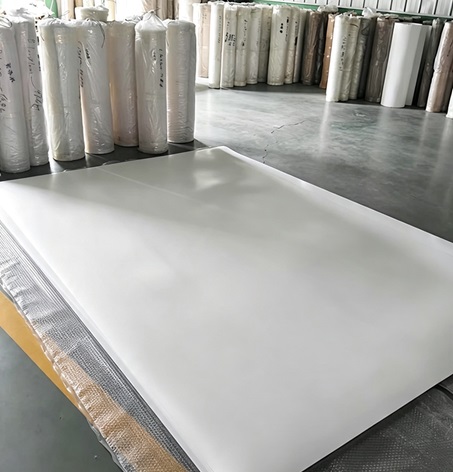
Flexible Teflon sheet is a high-performance flexible film made from PTFE (polytetrafluoroethylene). "Teflon" is simply the well-known commercial name for PTFE, and the material's distinctive molecular backbone is what gives it a heat tolerance, chemical resistance, and electrical performance far beyond ordinary plastics.
It's typically produced through extrusion, calendering, skiving, or specialized molding processes, and is available in a range of thicknesses and dimensions depending on the application. Compared to rigid PTFE sheet, the flexible version offers much better pliability, conformability, and machinability — which is exactly why it performs so well in space-constrained layouts, applications with sharp temperature swings, and precision electronic assembly work.
Key Performance Characteristics
1. Exceptional temperature tolerance. One of the material's biggest advantages is its thermal stability — PTFE can operate safely across a remarkably wide range, roughly -190°C to 260°C, without softening, melting, or losing mechanical properties. That range lines up perfectly with the demands of PCB hot-pressing, high-temperature electronic encapsulation, and aerospace environments.
2. Top-tier electrical insulation. A flexible Teflon sheet offers a very low dielectric constant (Dk) and dissipation factor (Df), which translates directly into lower signal transmission loss, more stable high-frequency response, and stronger dielectric withstand voltage — properties that make it a natural fit for 5G communications, radar, and RF PCB systems.
3. Outstanding non-stick surface properties. Thanks to its extremely low surface energy, PTFE has some of the best non-stick performance of any industrial material. In PCB production, that makes it an ideal release and isolation medium, preventing prepreg resin bleed and adhesive buildup — and significantly cutting down on equipment cleaning and maintenance.
4.Strong chemical stability. PTFE is highly chemically inert, resisting attack from most strong acids, strong bases, organic solvents, and strong oxidizers, which keeps it reliable even in demanding chemical processing and electronics manufacturing environments.
Main Applications in PCB Manufacturing
Flexible Teflon sheet shows up across a wide range of industries, but within the PCB and PCBA supply chain, it plays a central role as a high-performance auxiliary and structural material:
1. Multilayer PCB lamination release film: During the high-temperature, high-pressure lamination stage of multilayer board fabrication, prepreg resin flows and melts as copper foil and inner-layer circuitry are precisely aligned. Flexible Teflon sheet acts as a release film or separator sheet here, keeping resin from bonding to the press plates and meaningfully improving lamination yield.
2. High-frequency PCB and RF substrate applications: Its low Dk and low Df make it a common choice in microwave circuits, 5G antenna PCBs, and radar RF boards — meeting the strict low-signal-loss demands of millimeter-wave applications.
3. FPC flexible circuit manufacturing: Its flexibility combined with heat and moisture resistance make it a natural it as a high-temperature insulating layer or protective wrap in FPC production, extending the long-term mechanical life of flexible circuitry.
4. PCB equipment and tooling protection: Used as a press-plate cover, high-temperature tooling separator, or protective layer on manufacturing fixtures, it reduces equipment wear and keeps production lines running efficiently.
Why Flexible Teflon Sheet Outperforms Standard Materials
Compared to standard plastic or industrial films, flexible Teflon sheet has a clear edge on several fronts. Its temperature range is far wider — ordinary materials tend to deform under heat, while PTFE holds its structure over long-term exposure. Its electrical performance is stronger too: for high-speed, high-frequency electronics, low dielectric loss translates directly into reduced signal attenuation and better system stability. Chemical stability is another advantage, holding up reliably even in demanding industrial environments. And its service life is longer — capable of withstanding repeated thermal cycling, which suits it well to continuous manufacturing environments.
How to Choose the Right Flexible Teflon Sheet
A few factors matter most when selecting a PTFE release film or flexible Teflon sheet for your application:
1. Thickness: Different applications call for different thickness tolerances — PCB lamination release film needs precise thickness control, insulation applications need adequate mechanical strength, and high-frequency applications need thickness matched to the target electrical parameters.
2. Operating temperature requirements: Confirm the material can handle your lamination temperature, ambient operating environment, and long-term thermal cycling needs.
3. Electrical performance parameters: For high-frequency PCB applications, pay close attention to dielectric constant (Dk), dissipation factor (Df), and signal loss.
4. Surface treatment needs: Some applications call for etching, bonding treatment, or surface modification to improve how well the material bonds with adjacent layers.
Flexible Teflon sheet is far more than an ordinary industrial film — it's a critical material underpinning modern electronics manufacturing, high-frequency PCB design, and advanced industrial applications. With its combination of high heat resistance, low signal loss, non-stick performance, and outstanding chemical inertness, it plays an irreplaceable role in multilayer board lamination, RF and microwave systems, FPC production, and aerospace insulation. As 5G/6G communications, high-speed computing, and smart hardware continue to advance, flexible Teflon sheet will remain a foundational material powering the next generation of high-performance electronics.