A Trustworthy PCB and Electronic Manufacturing Enterprise! Contact Us


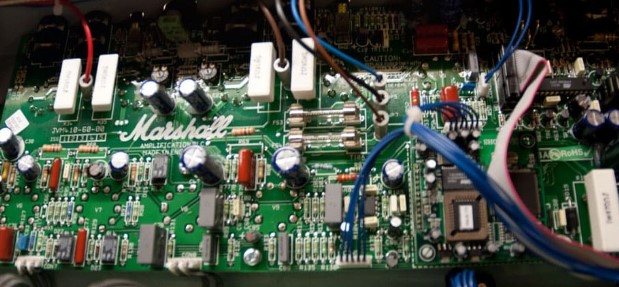
A Marshall PCB board is the printed circuit board inside a Marshall guitar amplifier, the green or brown laminate that carries the tone stack, the valve sockets and the controls. If you repair these amps, build a clone, or make a small run of replacement boards, the board is not just a piece of fibreglass. It decides whether the amp stays quiet, runs cool and survives another thirty years on the road. This guide covers what these boards are, how a good guitar amp PCB is made, and what to tell your fabricator before you order.
Marshall made its name with hand-wired amps, where components were soldered between tag strips and turrets with no printed circuit at all. Over the years the company moved many models to PCBs, to cut cost and keep every unit the same. That shift is the reason this keyword exists: players and technicians constantly need to repair, rebuild or reproduce those boards. A tube amp PCB is a tough thing to get right, because it combines high voltage, heat, vibration and very sensitive audio signals on the same piece of laminate.
Most owners meet the problem the same way. A board gets scorched around a valve socket, a copper track lifts after years of heat cycling, or a repair tech finds a cracked joint under a heavy electrolytic capacitor. Replacing it with a freshly made board is often better than patching. And for builders who want a particular circuit in a new chassis, a custom-made heavy copper PCB gives them a board that is built for the job. One point first: the boards a fabricator makes should come from the customer’s own design files. A factory makes the board from the Gerber data it is given, and reproducing someone else’s branded design without permission is a legal matter that the buyer has to settle.
What is actually on the board
A typical Marshall PCB holds several areas that behave very differently. The preamp section is low-level audio, with small resistors, coupling capacitors and the tone controls. Even a faint hum or a noisy track can be heard through a loud amp. The power section carries the high-voltage supply, often several hundred volts, and feeds the output valves. The valve sockets sit in between, with heavy pins and a lot of heat. Then there are the pots, jacks and switches, which are usually mounted on the chassis and wired to the board, or sometimes on the board itself.
Because so many different signals sit close together, layout matters more than most people expect. Guitar signals are tiny, and a trace running too near a power track can pick up hum. Good designers keep the high-voltage and the audio sections well apart, use a single ground point for the preamp, and route the heater wiring away from the input stage. A board that looks tidy but ignores these rules will hum, and no amount of component swapping will fully fix it.
Why the material and copper weight matter
Most boards for this kind of amp are standard FR-4 fibreglass, and for many designs that is enough. Where the board lives close to hot output valves, a higher temperature grade such as TG150 is worth the small extra cost, because ordinary laminate can brown and soften after years of heat. In older amps you will sometimes find a paper-based laminate that has darkened and turned brittle, which is one reason repairs are so common. Another is how heavy the parts are. A big reservoir capacitor, a transformer lead or a valve base puts real mechanical stress on its joints, and every time the amp is switched on and off the board expands and contracts.
Copper weight is the other lever. One ounce copper is common, and two ounce copper is better on the power section, since thicker tracks run cooler and survive more heat cycles. Generous pads around valve sockets help too, with big annular rings so the solder joint has plenty of copper to hold. Ask your fabricator to confirm the finished hole size for the valve pins and to keep the pads large, because small pads on heavy parts are the first thing to fail.
High voltage and spacing
A valve amp’s supply can run from a few hundred to over four hundred volts, so spacing between tracks is not a detail you can leave to the autorouter. The usual approach is to keep wider gaps in the high-voltage areas and, where space is tight, to cut slots in the board to lengthen the surface path between two points. Which spacing is right depends on the voltage, the humidity the amp will live in, and the safety standard it has to meet, so check the numbers against the standard for your market, not against a rule of thumb you remember from a forum.
Dust and damp are also real. An amp that spends years in a damp rehearsal room or in the back of a van collects moisture and grime, and that can create leakage paths across the board. A conformal coating helps, but it has to be applied on purpose, with the jacks, sockets and test points masked. Tell your supplier early if you want it, because masking is part of the process.
Finish, solder mask and silkscreen
Players and techs read these boards with a meter and a soldering iron, so the finish matters in practice. Lead-free HASL is cheap and fine for most through-hole work. ENIG gives a flatter surface and a better shelf life, which suits boards that sit in stock between orders. Solder mask colour is mostly personal. Green is the usual choice, black looks good, and some builders want red or blue to match a kit. The silkscreen deserves real care. Clear component labels, polarity marks on the capacitors, valve pin numbers and a visible board revision save a lot of confusion later, especially when the person soldering is a hobbyist, not a production line.
Small runs, many versions
This is not a high-volume market. Most orders for a Marshall PCB board are small, from ten to a few hundred pieces, and the same shop may need five or six variants: a preamp board, a power board, a reverb board and an effects-loop board. That suits a fabricator who is happy with low quantities and quick changes. Look for a supplier who will panel several designs together, who answers questions about drill sizes and tolerances in plain language, and who tells you when a part of your design is likely to cause trouble.
Lead time on a simple through-hole board is usually short, but extras such as heavy copper or a special finish add a few days. If you need a board by a certain date, say so when you ask for the quote, not after the order is placed.
Assembly and testing
Most through-hole amp boards are soldered by wave or selective soldering, or by hand for odd parts. Heavy components such as big capacitors need extra heat to wet properly, and a cold joint on a power rail can fail months later. After assembly, a simple continuity and short-circuit test catches many faults. A power-on test with a variac, bringing the voltage up slowly, is how repair techs check a rebuilt board before it goes back in the chassis. If you want your supplier to do this, agree the procedure in writing.
What to send for a quote
Send the Gerber files, a drill file, the board outline, the board thickness, the copper weight, the surface finish, the solder mask and silkscreen colours, and the quantity. If you want assembly, add the parts list with manufacturer part numbers and the placement drawing. Mention anything unusual, such as slots for high-voltage isolation, conformal coating or a particular laminate grade. If you are making a replacement for an existing board and have a sample, send clear photos of both sides and say which dimensions matter most.
A short note on names: Marshall is a registered trademark of its owner, and we are not affiliated with it. We make circuit boards from our customers’ own designs. If you are planning a repair, a custom build or a small production run of a Marshall PCB board, send your files to our team for a review and quotation, and we will tell you plainly what looks risky before anything is made.