A Trustworthy PCB and Electronic Manufacturing Enterprise! Contact Us


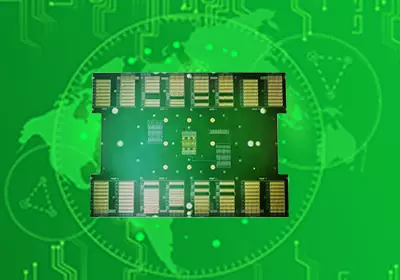
Circuit board labels—also known as circuit board labels—are specialized labels used to provide critical information during and after the printed circuit board (PCB) manufacturing process. These labels contain data such as serial numbers, QR codes, or barcodes, facilitating the tracking and identification of the board throughout its entire lifecycle. Just as a house cannot be built without a blueprint, PCB labels serve as a vital reference for manufacturers and technicians, offering key information about the board's internal structure. They help maintain quality control, traceability, and seamless logistics across various production stages. It is a small yet powerful solution essential for the smooth operation of the electronics industry.
Common Types of Circuit Board Labels
Circuit board labels can be categorized into various types based on their application scenarios and functions.
1. High-Temperature Labels
High-temperature labels are primarily used for circuit boards that undergo high-heat processes such as reflow soldering or wave soldering. Typically made from polyimide (PI) face stock, these labels can withstand short-term exposure to temperatures of 260°C or higher without detaching, deforming, or carbonizing. They are commonly used to identify boards undergoing SMT (Surface Mount Technology) assembly.
2. Anti-Static Labels
Anti-static labels are designed for electronic products and circuit boards that are sensitive to static electricity. Made from materials with conductive or anti-static properties, these labels prevent the label itself from becoming a source of electrostatic discharge, thereby protecting sensitive components on the circuit board.
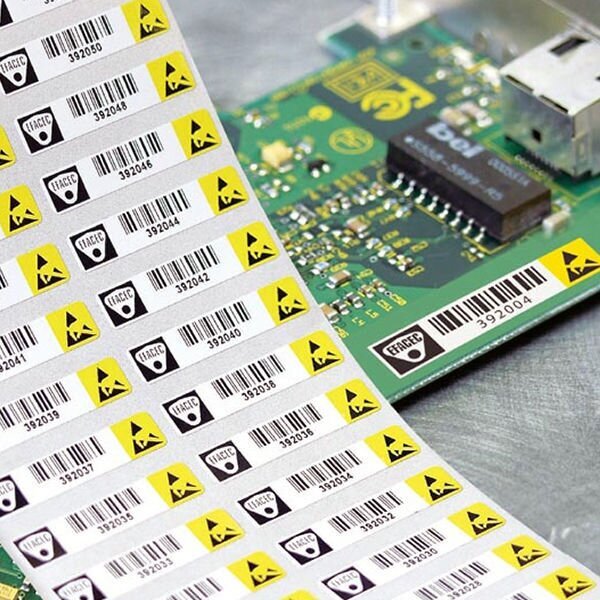
circuit board labels
3. Serial Number Labels
Serial number labels assign a unique identifier to each circuit board, facilitating production traceability, quality management, and after-sales service. These labels typically feature barcodes, QR codes, or Data Matrix codes that can be quickly read using scanning equipment.
4. Chemical-Resistant Labels
During PCB production, boards may come into contact with various chemicals, such as flux, cleaning agents, and developing solutions. Chemical-resistant labels are designed to remain intact and legible in these environments, ensuring the information does not fade, blur, or peel off.
5. Transparent Labels
Transparent labels are often used to cover specific areas of a circuit board; they provide protection without obscuring the text or graphics underneath. They are also frequently used for encapsulation or external identification purposes.
6. Removable Labels
Removable labels are used for temporary identification—such as marking the completion of specific steps during assembly—and can be easily peeled off later without leaving adhesive residue.
Circuit Board Label Materials and Manufacturing Processes
The performance of circuit board labels depends largely on the choice of materials. Common face materials include:
Paper: Low cost and suitable for general identification, but lacks resistance to high temperatures and chemical corrosion.
PET: Offers good temperature resistance and dimensional stability; suitable for most electronics manufacturing scenarios.
PI (Polyimide): Features excellent high-temperature resistance; suitable for high-heat processes like reflow soldering.
PVC: Highly flexible, though temperature resistance is moderate.
Synthetic Paper: Combines the printability of paper with the durability of plastic.
Application Scenarios for Circuit Board Labels
Circuit board labels are utilized throughout the entire electronics manufacturing lifecycle.
1. Production and Manufacturing Stage
At PCB manufacturing plants, labels identify information such as board numbers, batch numbers, production dates, and work order numbers. On SMT assembly lines, labels track the status of each board—indicating stages like "solder paste printed," "components placed," or "reflow soldered." During testing, labels record test results and the personnel who performed the tests.
2. Quality Traceability Stage
When quality issues arise, labels on the circuit board allow for rapid tracing of information—such as production batches, raw material suppliers, production equipment, and operators—to pinpoint the cause and implement corrective actions. This is particularly critical for industries with stringent reliability requirements, such as automotive and medical electronics.
3. Warehousing and Logistics Stage
In warehouses, circuit board labels facilitate efficient inbound and outbound processing as well as inventory management. Scanning the barcodes or QR codes on the labels enables automatic system entry, reducing human error and increasing efficiency.
4. After-sales Service Stage
During product repair or replacement, service personnel can use the circuit board label to verify the product model, version number, and date of manufacture, thereby selecting the appropriate repair method and spare parts.
Although a circuit board label is merely a small sticker affixed to the board, it serves multiple functions in electronics manufacturing, including identification, traceability, management, and protection. From production and quality traceability to warehousing, logistics, and after-sales service, these labels play a vital role throughout the product's entire lifecycle. Selecting the right label not only boosts production efficiency and reduces error rates but also enhances product quality and customer satisfaction.
As the electronics industry evolves toward higher density, greater reliability, and increased intelligence, circuit board labeling technology will continue to innovate, providing solutions that are more reliable, efficient, and environmentally friendly. For electronics manufacturers, prioritizing the selection and application of circuit board labels is a crucial step in enhancing overall competitiveness.