A Trustworthy PCB and Electronic Manufacturing Enterprise! Contact Us



A relay is an electronic component used to control circuits; it manages the making and breaking of a circuit by sensing changes in input current. Commonly used in automation control circuits, relays perform functions such as automatic regulation, isolation, safety protection, and signal switching. A relay typically features ground control pins on one side and Normally Open (NO), Normally Closed (NC), and Common (COM) terminals on the other. When unpowered, the NC and COM terminals are connected; when powered, the NO and COM terminals connect. Thus, the relay functions essentially as a switch. Relays were developed to protect circuits; they enhance circuit reliability, ensure electrical safety, and facilitate the development of power systems.
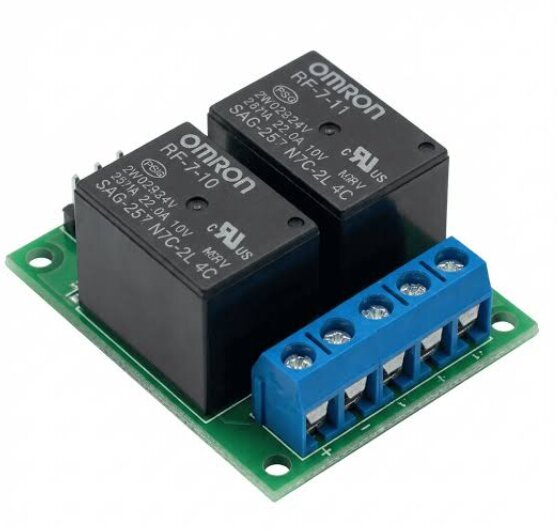
relay electronic component
Relays can be broadly categorized into two types: contact-based relays (mechanical relays) and contactless relays (MOSFET relays, solid-state relays).
Contact-based relays (mechanical relays): These feature physical contacts and use electromagnetic action to mechanically open or close them, thereby "connecting" or "disconnecting" signals, currents, or voltages.
Contactless relays (MOSFET relays, solid-state relays): Unlike contact-based relays, these lack moving mechanical parts; instead, they are composed of semiconductors and electronic components such as thyristors (SCRs) and MOSFETs. They use these electronic circuits to electronically "connect" or "disconnect" signals, currents, or voltages.
Core operating principles of a relay
Several core components within a relay work together to switch the circuit on and off. Key components include:
Coil: The primary driving component of the relay; it generates an electromagnetic field when voltage is applied.
Armature (or iron core): A movable component driven by electromagnetic force to actuate the contacts and complete the circuit switching.
Contacts: Metal contact points responsible for making or breaking the circuit connection and potentially managing input and output signals.
Spring assembly: Returns the relay to its initial state after the coil is de-energized.
Common types of relays
1. Standard (General-purpose) relays
Standard relays are versatile components suitable for a wide range of circuits. Characterized by their simple structure and ease of use, they are widely applied across various types of circuitry.
2. Time-delay Relay
Time-delay relays control the opening and closing of contacts based on preset time intervals, enabling timed switching of circuits. They are widely used in fields such as home appliances and industrial automation control.
3. Thermal Relay
Thermal relays utilize the thermal expansion of metals and the characteristics of heat-sensitive elements to control circuit switching. They are commonly found in home appliances like fans, air conditioners, and dryers.
Relay Testing
1. Measuring Contact Resistance
Use the resistance setting on a multimeter to measure the resistance between the normally closed (NC) contact and the moving contact; the reading should be 0 ohms. Conversely, the resistance between the normally open (NO) contact and the moving contact should be infinite. This allows you to distinguish between the normally closed and normally open contacts.
2. Measuring Coil Resistance
Use the R×10Ω setting on a multimeter to measure the resistance of the relay coil and determine if there is an open-circuit fault.
3. Measuring Pull-in Voltage and Pull-in Current
Connect an adjustable regulated power supply and an ammeter to the relay, placing the ammeter in series within the power supply circuit for monitoring. Gradually increase the supply voltage; when you hear the relay click (engage), record the pull-in voltage and pull-in current. To ensure accuracy, repeat the test several times and calculate the average value.
4. Measuring Release Voltage and Release Current
Set up the test as described above. After the relay has engaged, gradually lower the supply voltage. When you hear the relay click again (release), record the voltage and current at that moment. Again, you can repeat the test to obtain the average release voltage and release current. Generally, the release voltage is approximately 10% to 50% of the pull-in voltage. If the release voltage is too low (less than one-tenth of the pull-in voltage), the relay cannot be used normally; this compromises circuit stability and results in unreliable operation.