A Trustworthy PCB and Electronic Manufacturing Enterprise! Contact Us


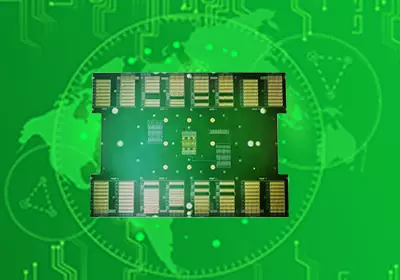
A smartphone PCB is the foundation of every smartphone. Whether you're lighting up the screen, launching an app, snapping a photo, or scrolling through short videos, it's the PCB inside the device that makes it all possible. Simply put, without the PCB, the smartphone in your hand wouldn't exist.
Most people, when buying a phone, look at the processor, screen, camera, and battery capacity, yet rarely ask: "How well-designed is the PCB?" This is hardly surprising, as the PCB is never the star of the show at smartphone launch events. However, those who truly understand hardware know that the PCB is the foundation of everything. Without it, chips are merely silicon wafers, screens are just glass, and cameras are just lenses; they would never be able to communicate with one another.
A "Highway Network" for Signals and Current
To understand the smartphone PCB, one must first grasp what is happening on the board itself.
Inside a smartphone, dozens—or even hundreds—of components (such as the main processor, memory, storage chips, RF front-end, Wi-Fi modules, power management chips, audio codecs, and various sensors) are all soldered onto a single PCB. They need to communicate and work in concert. This communication isn't achieved through visible wires, but through incredibly fine copper traces embedded within and on the surface of the PCB.
On a smartphone motherboard, trace widths and spacing are often measured in mere tens of microns—thinner than a human hair. This "highway network" must simultaneously handle various types of data transmission: high-speed data exchange (gigabytes per second) between the CPU and memory; the transmission and reception of high-frequency microwave signals between the baseband chip and the RF front-end; and the stable delivery of high current from the power management chip to various components. A well-designed PCB ensures these signals stay in their own lanes without interfering with one another; a poorly designed PCB leads to signal attenuation, electromagnetic interference, and timing errors—manifesting to the user as lag, dropped connections, rapid battery drain, or even system crashes and black screens.
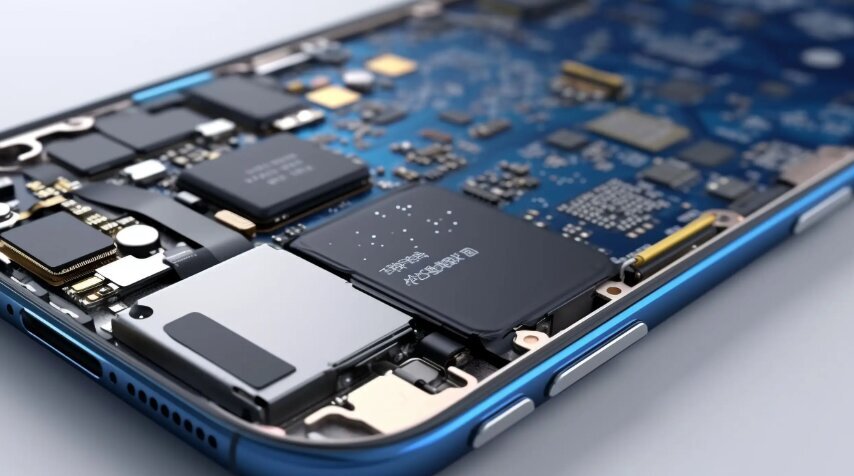
Smartphone PCB
Precisely for this reason, smartphone PCBs demand extremely rigorous design and manufacturing standards. Impedance control, layer stack-up design, signal integrity, power integrity, electromagnetic compatibility—these technical terms ultimately determine how well the phone in your hand actually performs. The Evolution of Smartphone PCBs
The evolution of smartphone PCBs reflects the rapid advancement of mobile technology over the past few decades. The demand for smaller, more powerful, and energy-efficient devices has driven this evolution—moving from early mobile phones that utilized simple single-layer PCBs to today's high-end smartphones featuring complex, multi-layer PCB designs.
Manufacturing modern smartphone PCBs requires advanced materials and fabrication processes. To ensure durability and reliability, high-quality substrates such as epoxy-glass fiber composites (FR-4) are used. The application of Surface Mount Technology (SMT) allows for the mounting of smaller components and further miniaturization of the PCB, enabling sleeker and more compact smartphone designs.
Smartphone PCB Structure and Components
A typical smartphone PCB integrates multiple components that work in concert. Key components include:
Core Layers and Materials:
Smartphone PCBs are typically constructed from materials such as FR-4, metal cores, or flexible substrates. FR-4 is the most common material, offering a balance between durability and cost, while metal-core PCBs are used in high-performance phones to provide superior heat dissipation.
Microprocessors, Chipsets, and SoCs (System-on-Chip):
The microprocessor serves as the phone's "brain," controlling all its functions. An SoC integrates multiple components—such as the CPU, GPU, and memory—onto a single chip, thereby saving space and reducing power consumption.
Power Management Unit (PMU) and Battery Connectors:
The PMU ensures the battery efficiently supplies power to the phone's various components, optimizing power consumption and extending battery life.
RF Modules and Antennas:
Radio Frequency (RF) modules handle wireless communications—including Wi-Fi, 4G/5G, Bluetooth, and GPS—while antennas on the PCB manage signal transmission and reception.
Display and Touchscreen Interface Components:
The PCB connects the touchscreen and display to the phone's main processing unit, controlling everything from the user interface to video output.
Audio and Microphone Circuitry Integration:
Audio circuitry—including microphones and speakers—is integrated into the PCB, enabling voice calls and media playback. Camera Module and Image Signal Processor (ISP):
Modern mobile phones require high-quality cameras; the PCB connects the camera module to the ISP (Image Signal Processor), which handles image processing and enhancement.
Why should mobile phones use multi-layer PCBs?
Smartphones are compact yet powerful, and multi-layer PCBs make this possible. Most new mobile phones utilize multi-layer PCB designs. These boards consist of stacked layers, allowing them to accommodate more components and complex circuitry.
Compact Size: Multi-layer PCBs are suitable for complex designs within confined spaces.
Lightweight Design: Fewer parts are required, resulting in a lighter phone.
High Reliability and Durability: Robust internal connections ensure a longer service life.
High Component Density: More components fit into a smaller space, enabling more powerful phone functionality.
Support for Complex Circuitry: Additional layers facilitate the handling of intricate designs.
Enhanced Performance: Superior design leads to faster and more effective signal transmission.
Multi-layer PCBs facilitate smooth power delivery and maintain signal clarity, providing the phone with stable voltage and reduced noise. This translates to better performance and increased longevity for the device.
Improved Performance: Although multi-layer PCBs come at a higher cost, their enhanced functionality and performance justify the investment. Designed to operate as a single unit, they are easier to install and integrate, ultimately boosting the phone's performance.
Overall, using multi-layer PCBs in mobile phones offers numerous advantages, including enhanced functionality, reduced size, and improved performance. While they may cost more than traditional PCBs, the benefits make them a worthwhile investment for manufacturers aiming to produce high-quality, high-performance devices.
In summary, smartphone PCBs are at the forefront of mobile technology innovation, driving the development of devices that are smaller, more powerful, and more energy-efficient. From early, simple single-layer boards to today's complex multi-layer designs, PCBs have played a pivotal role in the evolution of smartphones.
Looking ahead, as technological advancements drive further innovation in PCB design and manufacturing, their role in smartphones will become increasingly critical. By embracing these trends and pushing the boundaries of what is possible, smartphone PCB manufacturers can continue to deliver cutting-edge devices that meet the ever-changing needs of global consumers.