A Trustworthy PCB and Electronic Manufacturing Enterprise! Contact Us


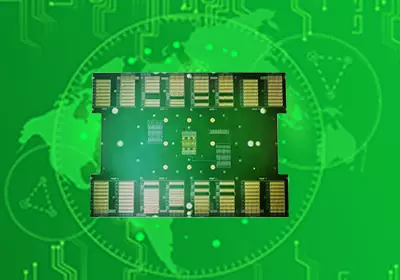
Among high-frequency PCB material systems, one substrate stands out for its near-ultimate electrical performance: PTFE PCB (PTFE stands for Polytetrafluoroethylene; Teflon is a trademark of DuPont). PTFE PCBs are high-frequency substrates composed of a PTFE resin matrix reinforced with materials such as glass fiber, ceramic fillers, or microfibers. Due to their extremely low dielectric constant and dissipation factor, they are the material of choice for high-end RF applications, including microwave, millimeter-wave, and satellite communications.
Performance Characteristics of PTFE PCBs
Compared to traditional FR-4 PCBs, PTFE PCBs offer significant advantages, making them particularly suitable for RF, microwave, and high-speed digital circuit applications. Their key performance characteristics include:
1. Low Dielectric Constant (Dk)
The dielectric constant of PTFE typically ranges from 2.0 to 2.5, whereas that of FR-4 is 4.2 to 4.8. A lower dielectric constant enables faster high-frequency signal transmission and reduced signal latency.
2. Extremely Low Dielectric Loss (Df)
PTFE materials exhibit very low dielectric loss, effectively minimizing energy attenuation in high-frequency signals. This is crucial for GHz-range signal transmission in applications such as 5G communications, satellite communications, and radar systems.
3. Low Moisture Absorption
PTFE has a water absorption rate of nearly zero, allowing it to maintain stable electrical performance even in high-humidity environments. This ensures that the circuit board preserves impedance matching and signal integrity in damp conditions.
4. Wide Temperature Adaptability
PTFE offers excellent high-temperature resistance, generally suitable for long-term use within a temperature range of -60°C to 260°C, making it ideal for various industrial and avionics environments.
5. Chemical Inertness
PTFE is virtually unreactive to acids, alkalis, and various chemical solvents, allowing for use in harsh environments and extending the service life of the PCB.
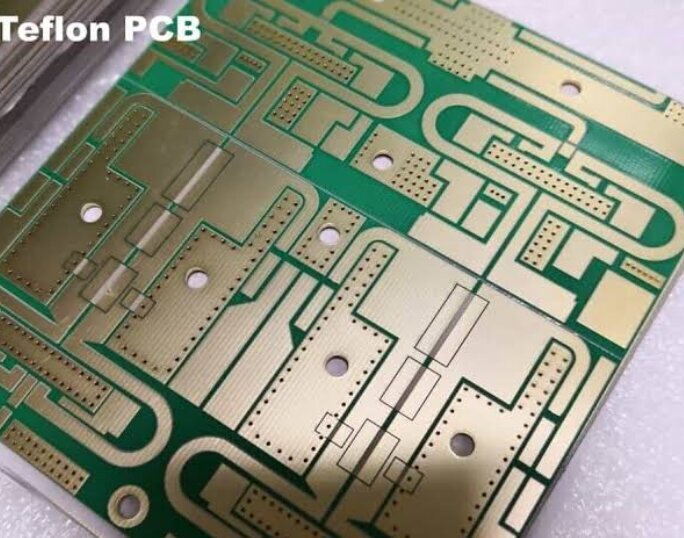
PTFE PCB
Major PTFE PCB Product Series and Selection Guide
Rogers RT/duroid Series: The Benchmark for PTFE High-Frequency Boards
The RT/duroid series from Rogers Corporation is the most globally recognized PTFE substrate product line and serves as the industry-standard reference material in the high-frequency PCB sector. Key models include:
RT/duroid 5870 (Dk=2.33, Df=0.0012 @ 10GHz): A PTFE/glass microfiber composite; a low-Dk variant suitable for broadband circuits and high-speed interconnects requiring minimal signal propagation delay.
RT/duroid 5880 (Dk=2.20, Df=0.0009 @ 10GHz): The model with the lowest Dk and Df in the entire series; it is the preferred choice for millimeter-wave frequencies (above 30GHz) and is widely used in Q-, V-, and W-band antenna and transmission line designs.
RT/duroid 6002 (Dk=2.94, Df=0.0012 @ 10GHz): A PTFE/ceramic composite with moderate Dk; it offers superior dimensional stability compared to the 5880 series and is suitable for circuits requiring miniaturization while maintaining low loss.
RT/duroid 6010 (Dk=10.2, Df=0.0023 @ 10GHz): A high-Dk PTFE substrate; it allows antenna size to be reduced to approximately one-fifth that of the RT5880, making it ideal for space-constrained multilayer antennas and dielectric resonator filters.
The greatest advantage of the RT/duroid series is its extremely high Dk precision (within ±0.05) and excellent batch-to-batch consistency; these qualities are critical for phased-array radar systems that require mass production and highly consistent antenna performance.
Taconic and Other Major PTFE Substrate Suppliers
In addition to Rogers, there are several other major suppliers in the global PTFE high-frequency board market worth noting:
Taconic: The TLY series (Dk=2.17–2.45) and TLC series from the US-based company Taconic are key competitors to Rogers' RT/duroid products. They offer comparable performance at a relatively lower price point, securing a significant market share in cost-sensitive industrial applications. Isola: Isola’s I-Tera MT40 series utilizes modified thermoset resins (non-PTFE). Although not classified as PTFE PCBs, they offer dissipation factor (Df) performance approaching that of PTFE in the 10–40 GHz range (Df ≈ 0.0035 at 10 GHz) while offering superior processability, making them a viable partial alternative to PTFE.
Domestic Brands: With increased R&D investment in high-frequency materials, domestic manufacturers such as Shengyi Technology and Huazheng New Material have launched various PTFE composite substrate products. Their dielectric constant (Dk) and Df performance are steadily approaching mainstream international standards, garnering increasing attention amidst the trend toward domestic substitution.
Application Areas for PTFE PCBs
PTFE PCBs are widely used in high-frequency and high-speed electronic systems, including but not limited to the following areas:
1. RF and Microwave Circuits
The low dielectric constant and low-loss characteristics of PTFE PCBs make them the preferred material for RF modules, microwave communication equipment, and satellite communication systems.
2. Radar Systems
Radar antennas and signal processing modules demand exceptional stability and low loss for high-frequency signals. PTFE PCBs effectively reduce insertion loss, ensuring the precision of radar signals.
3. 5G Communication Equipment
5G high-speed signal transmission operates at frequencies reaching several gigahertz, a range where traditional FR-4 materials struggle to meet requirements. PTFE PCBs ensure high-speed signal integrity while minimizing signal reflection and interference.
4. High-Speed Digital Circuits
For high-speed digital signals of 10 Gbps and above, fluctuations in dielectric constant and material loss significantly impact signal integrity. The low dielectric loss and stable performance of PTFE PCBs effectively improve signal quality.
PTFE PCBs are the premier choice for RF, high-frequency, and high-speed circuits; their outstanding electrical properties and environmental resilience ensure excellent performance in critical sectors such as 5G communications, radar, medical technology, and aerospace. While they entail higher costs than traditional FR-4 boards, their superior signal quality, reliability, and long-term stability fully justify the investment. If you are developing high-frequency or high-precision projects, PTFE PCBs offer an ideal solution for achieving stable, low-loss signal transmission.